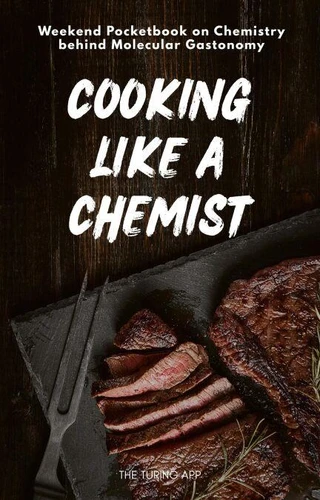
This book is an essential guide to the science of molecular gastronomy: the chemistry of turning your kitchen into a lab you can eat from. Written in everyday language, we explore how chefs use chemistry, physics, temperature, texture, aroma, and pressure to transform familiar ingredients into surprising experiences. What if olive oil could become powder, fruit juice could become pearls, or a steak could be cooked perfectly from edge to edge every single time? We begin with the origins of molecular gastronomy, from the work of Nicholas Kurti and Hervé This to the experimental kitchens of Ferran Adrià, Heston Blumenthal, and Grant Achatz.
Along the way, we ask how food became not just something we cook, but something we design. We explore spherification, the technique that turns liquids into delicate caviar-like pearls that burst in your mouth. We look at sodium alginate, calcium ions, and the simple chemical reaction that lets chefs turn juice, coffee, cocktails, or vinegar into edible bubbles of flavor. We move into emulsification, the science behind silky sauces, stable dressings, airy foams, and the mystery of how oil and water can be persuaded to stay together.
From mayonnaise and hollandaise to modern restaurant foams, we show how tiny molecules can change the entire texture of a dish. The book also explores sous vide precision cooking, the Maillard reaction behind browning, and the playful world of foams and carbonation. We ask why browned food tastes so rich, why controlled heat changes proteins so beautifully, and how gas can turn fruit, sauces, and drinks into something surprising. By the end, you will see cooking as a delicious experiment in chemistry, creativity, and curiosity.
This book is an essential guide to the science of molecular gastronomy: the chemistry of turning your kitchen into a lab you can eat from. Written in everyday language, we explore how chefs use chemistry, physics, temperature, texture, aroma, and pressure to transform familiar ingredients into surprising experiences. What if olive oil could become powder, fruit juice could become pearls, or a steak could be cooked perfectly from edge to edge every single time? We begin with the origins of molecular gastronomy, from the work of Nicholas Kurti and Hervé This to the experimental kitchens of Ferran Adrià, Heston Blumenthal, and Grant Achatz.
Along the way, we ask how food became not just something we cook, but something we design. We explore spherification, the technique that turns liquids into delicate caviar-like pearls that burst in your mouth. We look at sodium alginate, calcium ions, and the simple chemical reaction that lets chefs turn juice, coffee, cocktails, or vinegar into edible bubbles of flavor. We move into emulsification, the science behind silky sauces, stable dressings, airy foams, and the mystery of how oil and water can be persuaded to stay together.
From mayonnaise and hollandaise to modern restaurant foams, we show how tiny molecules can change the entire texture of a dish. The book also explores sous vide precision cooking, the Maillard reaction behind browning, and the playful world of foams and carbonation. We ask why browned food tastes so rich, why controlled heat changes proteins so beautifully, and how gas can turn fruit, sauces, and drinks into something surprising. By the end, you will see cooking as a delicious experiment in chemistry, creativity, and curiosity.

 , qui est-ce ?