Eureka Circe is the editor and curator of various book series on theology (e.g., "Unauthorized Grace" and "Deus Ex Machina"), as well as series on personal development and naturopathy. Also published are the volumes on women's politics "Alice and the Faith in Miracles - Where and Why Feminism Fails, " "MAIDEN'S MANIFESTO - The Female Flame, " "DEAD DANCE - The Trans Bible, " "DIGNITAS OMNIUM - The Dignity of All: The Vatican's Encyclical on Human Rights (Not Yet Set in Stone), " "DOGMA DELUXE, " and most recently in German language: "The 10 Pillars of Feminism, " "The Lexicon of Discourse Shift, " and "gender:goals - Twelve Goals of the Women's Movement."
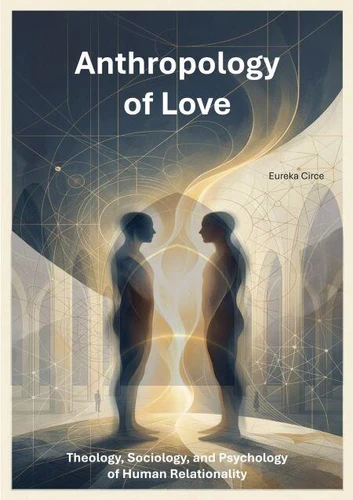
Anthropology of Love. Theology, Sociology, and Psychology of Human Relationality (Nulla Exclusio II)
Par :Formats :
Disponible dans votre compte client Decitre ou Furet du Nord dès validation de votre commande. Le format ePub est :
- Compatible avec une lecture sur My Vivlio (smartphone, tablette, ordinateur)
- Compatible avec une lecture sur liseuses Vivlio
- Pour les liseuses autres que Vivlio, vous devez utiliser le logiciel Adobe Digital Edition. Non compatible avec la lecture sur les liseuses Kindle, Remarkable et Sony
 , qui est-ce ?
Notre partenaire de plateforme de lecture numérique où vous retrouverez l'ensemble de vos ebooks gratuitement
Pour en savoir plus sur nos ebooks, consultez notre aide en ligne ici
C'est si simple ! Lisez votre ebook avec l'app Vivlio sur votre tablette, mobile ou ordinateur :

- Nombre de pages474
- FormatePub
- ISBN978-3-6963-0820-9
- EAN9783696308209
- Date de parution15/06/2026
- Protection num.pas de protection
- Taille5 Mo
- Infos supplémentairesepub
- ÉditeurBoD - Books on Demand
Résumé
What is love when it is more than just a feeling - when it becomes a bond, a responsibility, and a spiritual reality?
The Anthropology of Love unfolds relationship as the fundamental theme of human existence. Sociology, theology, and psychology are interwoven in a transdisciplinary manner: theologically, relationship appears as a place of grace, covenant, and communion; sociologically, as a form of recognition and public life; psychologically, as a space of attachment, vulnerability, maturation, and healing.
At the heart of this is the idea that human beings, as relational beings, do not find themselves in isolation, but only through dialogue, devotion, and responsibility toward another. This book develops an ethics of relationship that explores the truth of a relationship: with freedom, fidelity, responsibility, nonviolence, mutual dignity, capacity for reconciliation, and fruitfulness in the broadest sense. As a follow-up to Nulla Exclusio, Anthropology of Love further explores the question of ecclesial inclusion: Thus, the issue of same-sex couples or couples with divorced or ordained partners before the altar is not treated as a favorite topic, but as a litmus test of the Church's credibility.
The focus shifts: Not only same-sex relationships become a litmus test of the Church's credibility, but also celibate relationship structures and couples involving ordained persons. They stand at the heart of the Gospel and point to the fact that the Catholic Church must rethink its logic of relationships. If love is free, faithful, responsible, and life-affirming, the reform of mandatory celibacy toward voluntary celibacy becomes a necessary step toward a credible theology of relationships.
The theological consequence before the altar: no exclusion where relationships make God's grace visible. Nulla Exclusio II.
At the heart of this is the idea that human beings, as relational beings, do not find themselves in isolation, but only through dialogue, devotion, and responsibility toward another. This book develops an ethics of relationship that explores the truth of a relationship: with freedom, fidelity, responsibility, nonviolence, mutual dignity, capacity for reconciliation, and fruitfulness in the broadest sense. As a follow-up to Nulla Exclusio, Anthropology of Love further explores the question of ecclesial inclusion: Thus, the issue of same-sex couples or couples with divorced or ordained partners before the altar is not treated as a favorite topic, but as a litmus test of the Church's credibility.
The focus shifts: Not only same-sex relationships become a litmus test of the Church's credibility, but also celibate relationship structures and couples involving ordained persons. They stand at the heart of the Gospel and point to the fact that the Catholic Church must rethink its logic of relationships. If love is free, faithful, responsible, and life-affirming, the reform of mandatory celibacy toward voluntary celibacy becomes a necessary step toward a credible theology of relationships.
The theological consequence before the altar: no exclusion where relationships make God's grace visible. Nulla Exclusio II.
A propos de Eureka Circe




9,99 €