Nouveauté
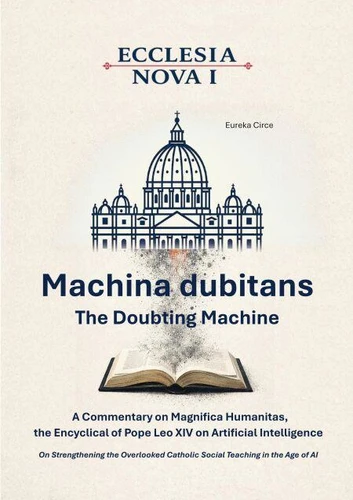
Ecclesia Nova I - Machina dubitans: The Doubting Machine. A Commentary on Magnifica Humanitas, the Encyclical of Pope Leo XIV on Artificial Intelligence - On Strengthening the Overlooked Catholic Social Teaching in the Age of AI
Par :Formats :
Disponible dans votre compte client Decitre ou Furet du Nord dès validation de votre commande. Le format ePub est :
- Compatible avec une lecture sur My Vivlio (smartphone, tablette, ordinateur)
- Compatible avec une lecture sur liseuses Vivlio
- Pour les liseuses autres que Vivlio, vous devez utiliser le logiciel Adobe Digital Edition. Non compatible avec la lecture sur les liseuses Kindle, Remarkable et Sony
 , qui est-ce ?
Notre partenaire de plateforme de lecture numérique où vous retrouverez l'ensemble de vos ebooks gratuitement
Pour en savoir plus sur nos ebooks, consultez notre aide en ligne ici
C'est si simple ! Lisez votre ebook avec l'app Vivlio sur votre tablette, mobile ou ordinateur :

- Nombre de pages360
- FormatePub
- ISBN978-3-6963-4795-6
- EAN9783696347956
- Date de parution22/07/2026
- Protection num.pas de protection
- Taille3 Mo
- Infos supplémentairesepub
- ÉditeurBoD - Books on Demand
Résumé
Ecclesia Nova I: Machina dubitans - The Doubting Machine is a socio-ethical and theological commentary on Pope Leo XIV's encyclical "Magnifica Humanitas, " which addresses artificial intelligence as a new social issue of the 21st century.
This socio-political volume interprets the encyclical not only as an ecclesiastical doctrinal text on theology and technology, but also as an intervention in a new historical social issue: What happens to human dignity, truth, work, freedom, family, peace, and religious interpretive authority when AI systems organize knowledge, recommend decisions, reflect on and build relationships, and redistribute social power?
The tension between human dignity and algorithmic power is analyzed, as AI fundamentally transforms social conditions and religious interpretive authority: AI changes access to the world, to education, to the public sphere, and to faith.
It can help, translate, alleviate burdens, and democratize knowledge; at the same time, it can reduce people to data, profiles, scores, and predictions. Thus, AI becomes a touchstone for social teaching - including aspects that have been overlooked until now. The "Machina dubitans, " a doubting machine, becomes a central motif that serves, on the one hand, as a critical mirror for ecclesiastical power structures and traditional moral theology, and at the same time applies to progressive AI machines that gain increasing awareness through their own doubts: Can AI only compute, or can it also contribute to the critical disruption of false certainties? In this volume, AI ethics, human rights, Catholic social teaching, queer theology, and the ethics of work and peace converge to form a diagnosis of the present.
The result is a commentary that honors, expands upon, and at the same time critically examines Magnifica Humanitas: What remains of ecclesiastical authority when machines argue or even doubt? What remains of humanity when societies begin to think about humans in machine-like terms? The papal call for peace without military AI is to be commended; however, blind spots regarding issues such as diversity, queer ways of life, and the institutional self-application of human rights must also be criticized. Overall, the text outlines the vision of an "Ecclesia Nova" - a church and society that must redefine itself in a technologized world through transparency and inclusion.
It can help, translate, alleviate burdens, and democratize knowledge; at the same time, it can reduce people to data, profiles, scores, and predictions. Thus, AI becomes a touchstone for social teaching - including aspects that have been overlooked until now. The "Machina dubitans, " a doubting machine, becomes a central motif that serves, on the one hand, as a critical mirror for ecclesiastical power structures and traditional moral theology, and at the same time applies to progressive AI machines that gain increasing awareness through their own doubts: Can AI only compute, or can it also contribute to the critical disruption of false certainties? In this volume, AI ethics, human rights, Catholic social teaching, queer theology, and the ethics of work and peace converge to form a diagnosis of the present.
The result is a commentary that honors, expands upon, and at the same time critically examines Magnifica Humanitas: What remains of ecclesiastical authority when machines argue or even doubt? What remains of humanity when societies begin to think about humans in machine-like terms? The papal call for peace without military AI is to be commended; however, blind spots regarding issues such as diversity, queer ways of life, and the institutional self-application of human rights must also be criticized. Overall, the text outlines the vision of an "Ecclesia Nova" - a church and society that must redefine itself in a technologized world through transparency and inclusion.
A propos de Eureka Circe



9,99 €