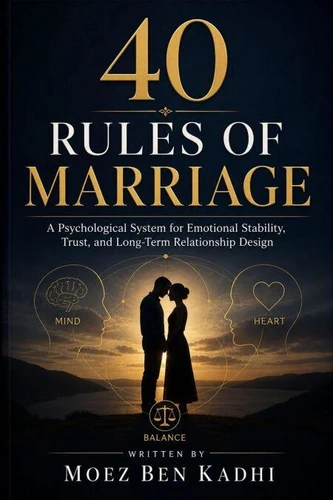
Marriage is not a static emotional state, nor is it maintained by affection alone. It is a continuously evolving psychological system shaped by communication patterns, emotional regulation, behavioral repetition, and mutual perception. What most people experience as "relationship problems" are rarely isolated events; they are the predictable outcomes of small, repeated interaction patterns that gradually define the emotional climate between two individuals.
This framework presents marriage not as romance preserved over time, but as a structured relational ecosystem that must be consciously maintained. Love, in this sense, is not merely felt, it is practiced, reinforced, and stabilized through behavior. The following principles form a unified model of relational psychology, where stability is not accidental but engineered through consistent emotional intelligence, behavioral discipline, and shared cognitive alignment.
Marriage is not a static emotional state, nor is it maintained by affection alone. It is a continuously evolving psychological system shaped by communication patterns, emotional regulation, behavioral repetition, and mutual perception. What most people experience as "relationship problems" are rarely isolated events; they are the predictable outcomes of small, repeated interaction patterns that gradually define the emotional climate between two individuals.
This framework presents marriage not as romance preserved over time, but as a structured relational ecosystem that must be consciously maintained. Love, in this sense, is not merely felt, it is practiced, reinforced, and stabilized through behavior. The following principles form a unified model of relational psychology, where stability is not accidental but engineered through consistent emotional intelligence, behavioral discipline, and shared cognitive alignment.

 , qui est-ce ?