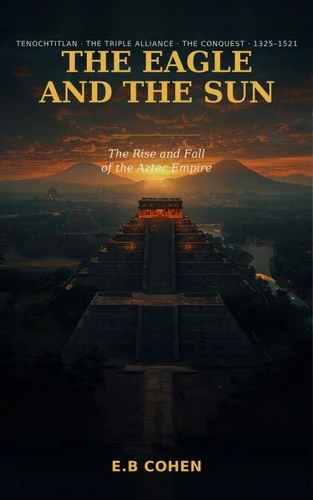
In the year 1325, a wandering and despised people saw a sign their god had promised them - an eagle perched on a cactus, on an island in a highland lake - and there they raised a city. Within a hundred years the Mexica had turned that reed-bound refuge into Tenochtitlan, the dazzling capital of the greatest empire the Americas had ever known: a metropolis of a quarter-million souls, laced with canals and causeways, fed by floating gardens, and ruled by a warrior aristocracy who believed the sun itself would die unless it was nourished with human blood. In The Eagle and the Sun, E.
B Cohen tells the whole sweep of that world - not just its violent end, but the astonishing civilization the Spanish found waiting for them. Here are the engineers who grew a city on water and the poet-king who wondered whether anything on earth is real; the merchants who walked to the edge of the known world and the schoolchildren who learned to read the painted books; the priests on the pyramid and the philosophers in the gardens of Texcoco; the emperors Moctezuma the Elder and Ahuitzotl who pushed the empire from sea to sea, and the tribute-bound peoples who came, at last, to hate it. And here is the fall: the strangers who came out of the eastern sea in 1519, the enslaved woman whose voice made the conquest possible, the smallpox that emptied the valley, and the ninety-three-day siege that reduced the city on the lake to rubble.
Sweeping, humane, and grounded in the latest archaeology and the voices of the Mexica themselves, this is the complete and gripping story of how a people built a world - and how that world came to an end, yet never entirely died.
In the year 1325, a wandering and despised people saw a sign their god had promised them - an eagle perched on a cactus, on an island in a highland lake - and there they raised a city. Within a hundred years the Mexica had turned that reed-bound refuge into Tenochtitlan, the dazzling capital of the greatest empire the Americas had ever known: a metropolis of a quarter-million souls, laced with canals and causeways, fed by floating gardens, and ruled by a warrior aristocracy who believed the sun itself would die unless it was nourished with human blood. In The Eagle and the Sun, E.
B Cohen tells the whole sweep of that world - not just its violent end, but the astonishing civilization the Spanish found waiting for them. Here are the engineers who grew a city on water and the poet-king who wondered whether anything on earth is real; the merchants who walked to the edge of the known world and the schoolchildren who learned to read the painted books; the priests on the pyramid and the philosophers in the gardens of Texcoco; the emperors Moctezuma the Elder and Ahuitzotl who pushed the empire from sea to sea, and the tribute-bound peoples who came, at last, to hate it. And here is the fall: the strangers who came out of the eastern sea in 1519, the enslaved woman whose voice made the conquest possible, the smallpox that emptied the valley, and the ninety-three-day siege that reduced the city on the lake to rubble.
Sweeping, humane, and grounded in the latest archaeology and the voices of the Mexica themselves, this is the complete and gripping story of how a people built a world - and how that world came to an end, yet never entirely died.

 , qui est-ce ?