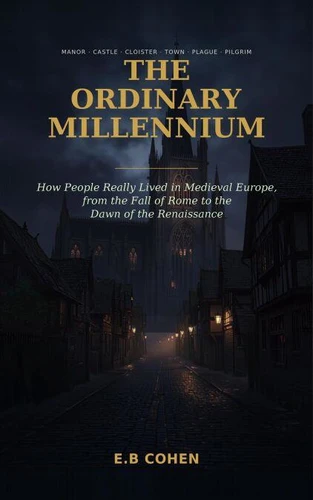
For a thousand years - from the last Roman emperor to the first printed book - Europe was neither dark nor stagnant nor filthy nor stupid, whatever the word medieval has been made to mean. It was a world of villages that governed themselves, peasants who sued their lords and won, women who brewed the beer and ran the businesses, and scholars who never for a moment doubted the Earth was round. The Ordinary Millennium is the whole of that world, told from the ground up.
Not a march of kings and battles but the texture of a single life inside the great machinery of manor, Church, castle and town: what people ate and wore, how they worked and worshipped and married and healed and died, and how much of what you think you know about them is a nineteenth-century invention. There were no chastity belts. There was no thousand years without a bath. The flat-earth story is a hoax younger than the telephone.
The passive, helpless serf is a caricature the court rolls demolish on every page. E. B Cohen tells the era as the evidence actually supports it - the plough and the horse collar that fed a continent, the bells and the first mechanical clocks that carved up the hour, the pilgrim roads and the traffic in holy bones, the guilds and the fairs and the new machinery of credit, and the century of famine and plague that killed one European in three and remade everything that came after.
Complete, rigorous, and alive to the strangeness and the ordinariness of it all - a single volume for readers who want the whole of the Middle Ages, and want to know how we know.
For a thousand years - from the last Roman emperor to the first printed book - Europe was neither dark nor stagnant nor filthy nor stupid, whatever the word medieval has been made to mean. It was a world of villages that governed themselves, peasants who sued their lords and won, women who brewed the beer and ran the businesses, and scholars who never for a moment doubted the Earth was round. The Ordinary Millennium is the whole of that world, told from the ground up.
Not a march of kings and battles but the texture of a single life inside the great machinery of manor, Church, castle and town: what people ate and wore, how they worked and worshipped and married and healed and died, and how much of what you think you know about them is a nineteenth-century invention. There were no chastity belts. There was no thousand years without a bath. The flat-earth story is a hoax younger than the telephone.
The passive, helpless serf is a caricature the court rolls demolish on every page. E. B Cohen tells the era as the evidence actually supports it - the plough and the horse collar that fed a continent, the bells and the first mechanical clocks that carved up the hour, the pilgrim roads and the traffic in holy bones, the guilds and the fairs and the new machinery of credit, and the century of famine and plague that killed one European in three and remade everything that came after.
Complete, rigorous, and alive to the strangeness and the ordinariness of it all - a single volume for readers who want the whole of the Middle Ages, and want to know how we know.

 , qui est-ce ?