For five hundred years the Roman Empire was the largest, richest, most durable state the western world had ever seen - a machine of roads and legions and law that ran from the moors of Britain to the sands of Arabia. And then, across a single tumultuous century, the western half of it came apart in the hands of its own generals and the peoples it could no longer keep out. In the year 476 a Germanic officer named Odoacer deposed a teenage emperor called Romulus Augustulus, declined to name a successor, and sent the imperial crown east to Constantinople.
The empire in the West was over. The Fall of Rome tells the whole of that story - not a single argument but the complete arc, from the near-fatal Crisis of the Third Century, through the astonishing remaking of the state under Diocletian and Constantine, to the storm of migration and civil war that finally broke it, and its long, strange afterlife in Justinian's doomed reconquest and the birth of medieval Europe.
Here are the battles that decided it (Adrianople, the Catalaunian Plains), the men who fought to hold it together (Stilicho, Aetius, the last of the Romans) and the ones who tore it apart (Alaric, Gaiseric, Attila the Hun), the debased coins and the empty treasury, and the volcano and the plague that historians now believe finished the job. And it does what most books on the subject refuse to do: it takes the greatest question in history - why did Rome fall? - and lays out every serious answer fairly, from catastrophe to migration to internal rot to climate and contagion, so that you can weigh them yourself.
Complete, rigorous, and gripping, it is the one volume for readers who want the entire story of the most famous collapse ever - and want to know how we know.
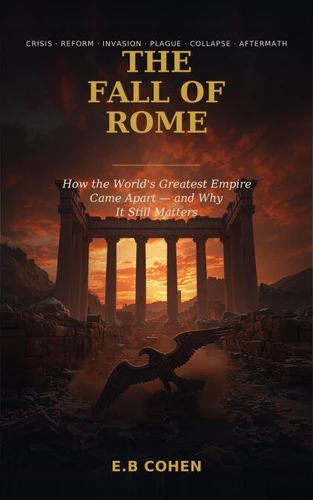
For five hundred years the Roman Empire was the largest, richest, most durable state the western world had ever seen - a machine of roads and legions and law that ran from the moors of Britain to the sands of Arabia. And then, across a single tumultuous century, the western half of it came apart in the hands of its own generals and the peoples it could no longer keep out. In the year 476 a Germanic officer named Odoacer deposed a teenage emperor called Romulus Augustulus, declined to name a successor, and sent the imperial crown east to Constantinople.
The empire in the West was over. The Fall of Rome tells the whole of that story - not a single argument but the complete arc, from the near-fatal Crisis of the Third Century, through the astonishing remaking of the state under Diocletian and Constantine, to the storm of migration and civil war that finally broke it, and its long, strange afterlife in Justinian's doomed reconquest and the birth of medieval Europe.
Here are the battles that decided it (Adrianople, the Catalaunian Plains), the men who fought to hold it together (Stilicho, Aetius, the last of the Romans) and the ones who tore it apart (Alaric, Gaiseric, Attila the Hun), the debased coins and the empty treasury, and the volcano and the plague that historians now believe finished the job. And it does what most books on the subject refuse to do: it takes the greatest question in history - why did Rome fall? - and lays out every serious answer fairly, from catastrophe to migration to internal rot to climate and contagion, so that you can weigh them yourself.
Complete, rigorous, and gripping, it is the one volume for readers who want the entire story of the most famous collapse ever - and want to know how we know.

 , qui est-ce ?