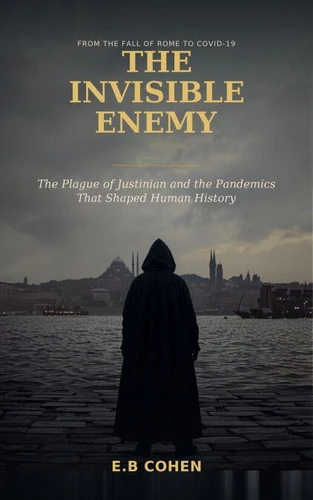
In the spring of 542, a sickness with no name reached the greatest city on earth. Within weeks it was killing thousands of the people of Constantinople every day; the emperor Justinian, at the height of his dream to restore the Roman world, caught it and barely survived; and the dead were stacked in the towers of the sea-wall because there was no ground left to bury them. It was the first act of a pandemic that would return in waves for two hundred years - and it would be another fifteen centuries before science could finally name the killer: a single bacterium, carried by a flea, riding on a rat. The Invisible Enemy tells that story in full, cinematic detail - the emperor and his empress, the eyewitnesses who watched their world come apart, the darkened sky of 536, and the fierce modern argument over whether the plague truly ended antiquity.
Then it opens the door wider, following the invisible enemy across three thousand years: the fever that killed Pericles, the Black Death that unmade feudal Europe, the smallpox that emptied the Americas, the cholera that built modern public health, the influenza of 1918, and the long road to COVID-19 and the vaccines that answered it. Warm, vivid, and honest about what we still argue over, this is the one book for anyone who has ever wondered how a thing too small to see could bring down empires - and how, at last, we learned to fight back.
In the spring of 542, a sickness with no name reached the greatest city on earth. Within weeks it was killing thousands of the people of Constantinople every day; the emperor Justinian, at the height of his dream to restore the Roman world, caught it and barely survived; and the dead were stacked in the towers of the sea-wall because there was no ground left to bury them. It was the first act of a pandemic that would return in waves for two hundred years - and it would be another fifteen centuries before science could finally name the killer: a single bacterium, carried by a flea, riding on a rat. The Invisible Enemy tells that story in full, cinematic detail - the emperor and his empress, the eyewitnesses who watched their world come apart, the darkened sky of 536, and the fierce modern argument over whether the plague truly ended antiquity.
Then it opens the door wider, following the invisible enemy across three thousand years: the fever that killed Pericles, the Black Death that unmade feudal Europe, the smallpox that emptied the Americas, the cholera that built modern public health, the influenza of 1918, and the long road to COVID-19 and the vaccines that answered it. Warm, vivid, and honest about what we still argue over, this is the one book for anyone who has ever wondered how a thing too small to see could bring down empires - and how, at last, we learned to fight back.

 , qui est-ce ?