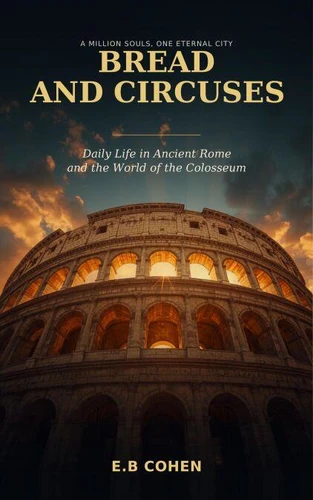
At dawn a million people stir in the greatest city the ancient world had ever built. In the apartment blocks the poor climb down five flights to buy hot food from a street counter; in the great houses the master receives his clients; water pours from a thousand fountains along stone channels that run for miles; and across the city, on the drained lake of a mad emperor's palace, stands a mountain of travertine and sand where later that day fifty thousand Romans will take their assigned seats by rank and wait for the games to begin. Bread and Circuses tells the whole story of ordinary life in ancient Rome - in vivid, cinematic scenes and plain, patient explanation - and then delivers its most astonishing spectacle in full.
Here are the insula and the domus, the toga and the tunic, the garum and the wine, the baths and the barber, the schoolroom and the slave market, the household gods and the roaring circus. And here, at the heart of it, is the Colosseum: how it was built and how it worked, the awning rigged by sailors and the labyrinth of lifts beneath the sand, the beast hunts of the morning and the executions of the terrible noon, the gladiators - who they really were, how they trained, and how often they actually died - and the crowd and the emperor locked together in the oldest theatre of power. Warm, surprising, and gloriously readable, this is the one book for anyone who has ever wondered what it was truly like to be Roman - and why, two thousand years later, we still meet Rome everywhere we look.
At dawn a million people stir in the greatest city the ancient world had ever built. In the apartment blocks the poor climb down five flights to buy hot food from a street counter; in the great houses the master receives his clients; water pours from a thousand fountains along stone channels that run for miles; and across the city, on the drained lake of a mad emperor's palace, stands a mountain of travertine and sand where later that day fifty thousand Romans will take their assigned seats by rank and wait for the games to begin. Bread and Circuses tells the whole story of ordinary life in ancient Rome - in vivid, cinematic scenes and plain, patient explanation - and then delivers its most astonishing spectacle in full.
Here are the insula and the domus, the toga and the tunic, the garum and the wine, the baths and the barber, the schoolroom and the slave market, the household gods and the roaring circus. And here, at the heart of it, is the Colosseum: how it was built and how it worked, the awning rigged by sailors and the labyrinth of lifts beneath the sand, the beast hunts of the morning and the executions of the terrible noon, the gladiators - who they really were, how they trained, and how often they actually died - and the crowd and the emperor locked together in the oldest theatre of power. Warm, surprising, and gloriously readable, this is the one book for anyone who has ever wondered what it was truly like to be Roman - and why, two thousand years later, we still meet Rome everywhere we look.

 , qui est-ce ?