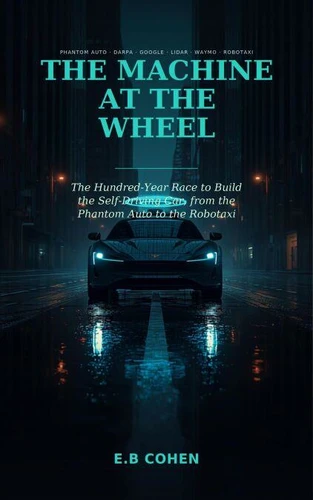
For a hundred years we dreamed of a car that would drive itself, and for a hundred years we got it wrong. We buried cables in highways and built radio-controlled stunts; we promised, again and again, that the driverless age was one year away. Then, in a single decade, it arrived - quietly, in the back seat of a car in Phoenix with no one in front. The Machine at the Wheel is the whole of that story.
It runs from the phantom autos of the 1920s and the automated-highway fantasies of Futurama, through the German engineer who taught a van to see and the DARPA desert races that turned science fiction into an engineering discipline, to the Google gold rush, the bitter trade-secret war, and the two deaths - a pedestrian in Tempe, a woman dragged in San Francisco - that forced the industry to grow up. E.
B Cohen braids the human drama with a clear, patient explanation of how the machine actually works: the ladder of autonomy and the all-important Operational Design Domain; the war between lidar and Tesla's camera-only bet; perception, prediction, planning, and the maddening "long tail" of edge cases that made the last one percent the whole problem. And the book carries the story right up to mid-2026 - Waymo at half a million rides a week, Tesla's robotaxi in Austin, Aurora's driverless trucks on Texas highways - while refusing the easy hype: correcting the myth that Level 2 is self-driving, that the car must "choose who to kill, " that full autonomy is always just around the corner.
A single, rigorous, deeply readable volume for anyone who has ever wondered who - or what - is really driving.
For a hundred years we dreamed of a car that would drive itself, and for a hundred years we got it wrong. We buried cables in highways and built radio-controlled stunts; we promised, again and again, that the driverless age was one year away. Then, in a single decade, it arrived - quietly, in the back seat of a car in Phoenix with no one in front. The Machine at the Wheel is the whole of that story.
It runs from the phantom autos of the 1920s and the automated-highway fantasies of Futurama, through the German engineer who taught a van to see and the DARPA desert races that turned science fiction into an engineering discipline, to the Google gold rush, the bitter trade-secret war, and the two deaths - a pedestrian in Tempe, a woman dragged in San Francisco - that forced the industry to grow up. E.
B Cohen braids the human drama with a clear, patient explanation of how the machine actually works: the ladder of autonomy and the all-important Operational Design Domain; the war between lidar and Tesla's camera-only bet; perception, prediction, planning, and the maddening "long tail" of edge cases that made the last one percent the whole problem. And the book carries the story right up to mid-2026 - Waymo at half a million rides a week, Tesla's robotaxi in Austin, Aurora's driverless trucks on Texas highways - while refusing the easy hype: correcting the myth that Level 2 is self-driving, that the car must "choose who to kill, " that full autonomy is always just around the corner.
A single, rigorous, deeply readable volume for anyone who has ever wondered who - or what - is really driving.

 , qui est-ce ?