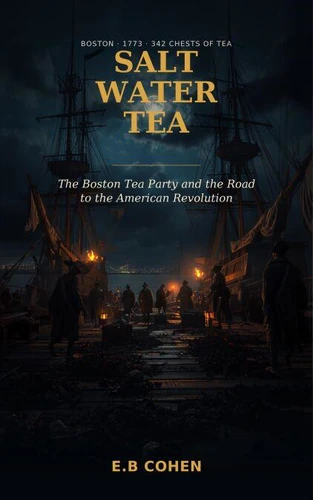
On the night of the sixteenth of December, 1773, after the largest town meeting Boston had ever seen broke up in the winter dark, a body of men with soot-blackened faces marched to Griffin's Wharf, boarded three merchant ships, and in three orderly hours threw three hundred and forty-two chests of the East India Company's tea into the harbor. They harmed no one and stole nothing. And they changed the world. Salt Water Tea tells the whole of that story, from first principles to its long echo.
It explains, in plain language anyone can follow, how a war-bankrupt empire, a nearly bankrupt trading company, a mountain of unsold tea, and a three-penny tax collided in a single Boston harbor - and why colonists were willing to destroy a fortune rather than pay a duty that would actually have made their tea cheaper. It reconstructs the crowded, quarrelsome road to that night: the Stamp Act and the Massacre, the smugglers and the Sons of Liberty, the stubborn royal governor and the young ship-owner caught in the middle.
And it follows the consequences - a harbor sealed shut, a continent enraged, a Congress summoned, and, sixteen months later, the first shots at Lexington. Complete, balanced, and gripping, correcting the durable myths and giving the Loyalist side its due, it is the one book for anyone who wants to understand how a protest over tea became the opening act of American independence - and why we have argued about its meaning ever since.
On the night of the sixteenth of December, 1773, after the largest town meeting Boston had ever seen broke up in the winter dark, a body of men with soot-blackened faces marched to Griffin's Wharf, boarded three merchant ships, and in three orderly hours threw three hundred and forty-two chests of the East India Company's tea into the harbor. They harmed no one and stole nothing. And they changed the world. Salt Water Tea tells the whole of that story, from first principles to its long echo.
It explains, in plain language anyone can follow, how a war-bankrupt empire, a nearly bankrupt trading company, a mountain of unsold tea, and a three-penny tax collided in a single Boston harbor - and why colonists were willing to destroy a fortune rather than pay a duty that would actually have made their tea cheaper. It reconstructs the crowded, quarrelsome road to that night: the Stamp Act and the Massacre, the smugglers and the Sons of Liberty, the stubborn royal governor and the young ship-owner caught in the middle.
And it follows the consequences - a harbor sealed shut, a continent enraged, a Congress summoned, and, sixteen months later, the first shots at Lexington. Complete, balanced, and gripping, correcting the durable myths and giving the Loyalist side its due, it is the one book for anyone who wants to understand how a protest over tea became the opening act of American independence - and why we have argued about its meaning ever since.


 , qui est-ce ?