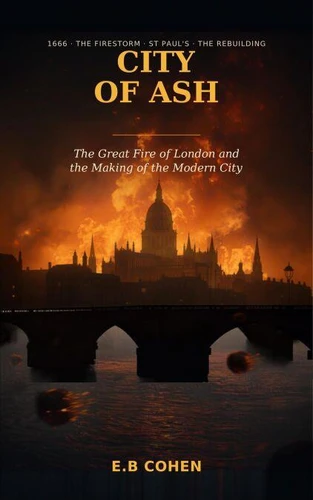
In the small hours of Sunday, 2 September 1666, a fire began in a baker's house on a narrow lane called Pudding, a stone's throw from London Bridge. Four days later, the medieval City of London - a square mile of timber houses packed along twisting lanes - was gone: thirteen thousand houses, eighty-seven churches, the Royal Exchange, the Guildhall, and St Paul's Cathedral itself, all consumed, and the homes of seventy thousand people erased.
It was one of the greatest urban catastrophes in history. It was also a beginning. City of Ash tells the whole of it, from first principles to the frontier. It reconstructs the flammable, teeming city that stood ready to burn, and explains - in plain language - exactly how fire spreads through a city and why a river of water could not save one built of wood. It follows the four days hour by hour, through the eyes of the diarists Samuel Pepys and John Evelyn, from the Lord Mayor's fatal hesitation to the burning of St Paul's, whose molten lead ran down Ludgate Hill.
It tells the ugly aftermath of rumour and blame, and the innocent Frenchman hanged as a scapegoat. And it follows the long consequences - the building codes, the Fire Court, fire insurance, the fire brigade, and Christopher Wren's new cathedral - that made the fire the birthplace of the modern city. Complete, balanced, and gripping, correcting the durable myths and honouring the uncounted dead, it is the one book for anyone who wants to understand how a great city burned, and how - brick by brick, code by code, stone by stone - it rose again.
In the small hours of Sunday, 2 September 1666, a fire began in a baker's house on a narrow lane called Pudding, a stone's throw from London Bridge. Four days later, the medieval City of London - a square mile of timber houses packed along twisting lanes - was gone: thirteen thousand houses, eighty-seven churches, the Royal Exchange, the Guildhall, and St Paul's Cathedral itself, all consumed, and the homes of seventy thousand people erased.
It was one of the greatest urban catastrophes in history. It was also a beginning. City of Ash tells the whole of it, from first principles to the frontier. It reconstructs the flammable, teeming city that stood ready to burn, and explains - in plain language - exactly how fire spreads through a city and why a river of water could not save one built of wood. It follows the four days hour by hour, through the eyes of the diarists Samuel Pepys and John Evelyn, from the Lord Mayor's fatal hesitation to the burning of St Paul's, whose molten lead ran down Ludgate Hill.
It tells the ugly aftermath of rumour and blame, and the innocent Frenchman hanged as a scapegoat. And it follows the long consequences - the building codes, the Fire Court, fire insurance, the fire brigade, and Christopher Wren's new cathedral - that made the fire the birthplace of the modern city. Complete, balanced, and gripping, correcting the durable myths and honouring the uncounted dead, it is the one book for anyone who wants to understand how a great city burned, and how - brick by brick, code by code, stone by stone - it rose again.

 , qui est-ce ?