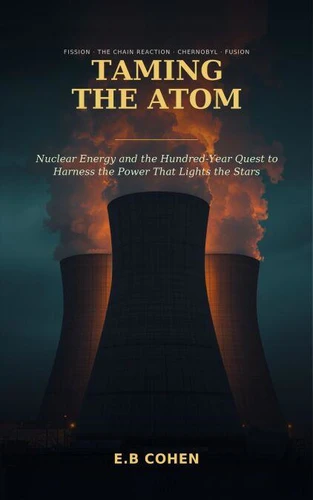
Inside a fuel pellet the size of a fingertip lies the energy of a tonne of coal. Learning to release it - safely, steadily, on demand - was one of the great scientific dramas of the twentieth century, and it may yet decide the fate of the twenty-first. This is the complete story of nuclear energy. E. B Cohen begins with the physics itself, made genuinely understandable: what an atom is, why splitting one releases a torrent of energy, and how a fraction-of-a-percent quirk of timing - the delayed neutron - is the only reason a reactor can be controlled at all.
Then comes the human drama: Becquerel's fogged photographic plate, Marie Curie's freezing shed, Lise Meitner working out the meaning of fission in the Christmas snow, and Enrico Fermi coaxing the first chain reaction to life beneath the stands of a Chicago football field. From there the book tells the whole arc of the peaceful atom - the first four lightbulbs lit in an Idaho desert, the reactors that now supply a tenth of the world's electricity, and the accidents that scarred it: the meltdown at Three Mile Island, the catastrophe at Chernobyl, the wave at Fukushima.
Cohen separates the myths from the measurements, explaining what radiation actually does, why nuclear power turns out to be among the safest energy sources ever measured, and how we plan to bury our waste for a hundred thousand years. And it carries the story to the present moment: a startling revival driven by climate targets and the electricity-hungry data centers of the AI age, the small modular reactors now being built, and the fusion machines that have finally, for a few billionths of a second, lit a star on Earth.
This is the story of the most concentrated power humanity has ever touched - and of the century-long struggle to tame it.
Inside a fuel pellet the size of a fingertip lies the energy of a tonne of coal. Learning to release it - safely, steadily, on demand - was one of the great scientific dramas of the twentieth century, and it may yet decide the fate of the twenty-first. This is the complete story of nuclear energy. E. B Cohen begins with the physics itself, made genuinely understandable: what an atom is, why splitting one releases a torrent of energy, and how a fraction-of-a-percent quirk of timing - the delayed neutron - is the only reason a reactor can be controlled at all.
Then comes the human drama: Becquerel's fogged photographic plate, Marie Curie's freezing shed, Lise Meitner working out the meaning of fission in the Christmas snow, and Enrico Fermi coaxing the first chain reaction to life beneath the stands of a Chicago football field. From there the book tells the whole arc of the peaceful atom - the first four lightbulbs lit in an Idaho desert, the reactors that now supply a tenth of the world's electricity, and the accidents that scarred it: the meltdown at Three Mile Island, the catastrophe at Chernobyl, the wave at Fukushima.
Cohen separates the myths from the measurements, explaining what radiation actually does, why nuclear power turns out to be among the safest energy sources ever measured, and how we plan to bury our waste for a hundred thousand years. And it carries the story to the present moment: a startling revival driven by climate targets and the electricity-hungry data centers of the AI age, the small modular reactors now being built, and the fusion machines that have finally, for a few billionths of a second, lit a star on Earth.
This is the story of the most concentrated power humanity has ever touched - and of the century-long struggle to tame it.


 , qui est-ce ?