In 1872 a bank-note engraver turned museum assistant sat down in London with a broken piece of clay and read, for the first time in two thousand years, an account of a great flood written centuries before the Book of Genesis. The civilisation he was reading had invented the city, the contract, the school, the library and the written word - and then been so completely forgotten that armies marched past its ruins without knowing whose they were.
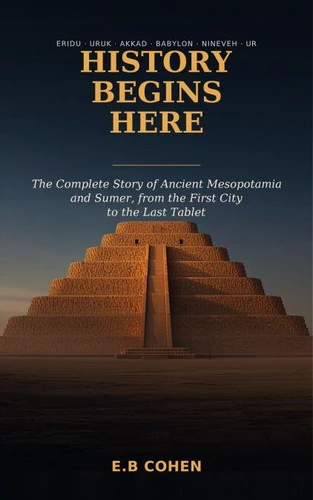
This is the whole story, end to end: from the first mudbrick shrine at Eridu to the last cuneiform tablet, an astronomical almanac written in AD 79 by a man who did not know he was the last. But History Begins Here is also a book about how much of what you have been told is wrong. Hammurabi's famous law code is never cited in a single surviving court judgment - because it may not be a law code at all.
There is no Akkadian word for "prostitute, " and sacred prostitution did not happen. The Baghdad Battery is Parthian, postdates Sumer by two thousand years, and has no positive terminal. The Hanging Gardens were probably not in Babylon and probably not Nebuchadnezzar's. The world's oldest customer complaint is funnier than the meme, because Ea-nasir kept the letters. And ama-gi, the first written word for freedom, is on the wrong king's monument in a great many books.
E. B Cohen tells three thousand years as the evidence actually supports it - the fights as well as the findings. Whether Uruk had fifty thousand people or nobody can say. Whether the tokens really became writing, and why the scholars who say so are no longer winning. Whether Enheduanna wrote a word of what bears her name. What Plimpton 322 is really for, in the fiercest argument mathematics has ever had about a lump of clay.
And it tells the part most books leave out: the getting it back. The cliff at Behistun. The sealed envelopes of 1857, when four men translated the same text separately to prove a whole discipline was not inventing it. Woolley pouring plaster into the holes where lyres had rotted away. Complete, rigorous, and honest about its own limits - a single volume for readers who want the whole thing, and want to know how we know.
In 1872 a bank-note engraver turned museum assistant sat down in London with a broken piece of clay and read, for the first time in two thousand years, an account of a great flood written centuries before the Book of Genesis. The civilisation he was reading had invented the city, the contract, the school, the library and the written word - and then been so completely forgotten that armies marched past its ruins without knowing whose they were.
This is the whole story, end to end: from the first mudbrick shrine at Eridu to the last cuneiform tablet, an astronomical almanac written in AD 79 by a man who did not know he was the last. But History Begins Here is also a book about how much of what you have been told is wrong. Hammurabi's famous law code is never cited in a single surviving court judgment - because it may not be a law code at all.
There is no Akkadian word for "prostitute, " and sacred prostitution did not happen. The Baghdad Battery is Parthian, postdates Sumer by two thousand years, and has no positive terminal. The Hanging Gardens were probably not in Babylon and probably not Nebuchadnezzar's. The world's oldest customer complaint is funnier than the meme, because Ea-nasir kept the letters. And ama-gi, the first written word for freedom, is on the wrong king's monument in a great many books.
E. B Cohen tells three thousand years as the evidence actually supports it - the fights as well as the findings. Whether Uruk had fifty thousand people or nobody can say. Whether the tokens really became writing, and why the scholars who say so are no longer winning. Whether Enheduanna wrote a word of what bears her name. What Plimpton 322 is really for, in the fiercest argument mathematics has ever had about a lump of clay.
And it tells the part most books leave out: the getting it back. The cliff at Behistun. The sealed envelopes of 1857, when four men translated the same text separately to prove a whole discipline was not inventing it. Woolley pouring plaster into the holes where lyres had rotted away. Complete, rigorous, and honest about its own limits - a single volume for readers who want the whole thing, and want to know how we know.

 , qui est-ce ?