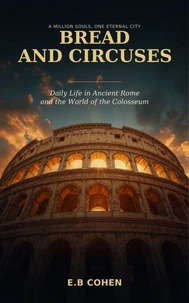
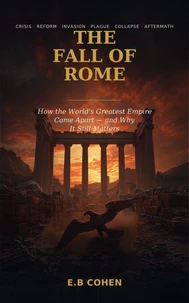
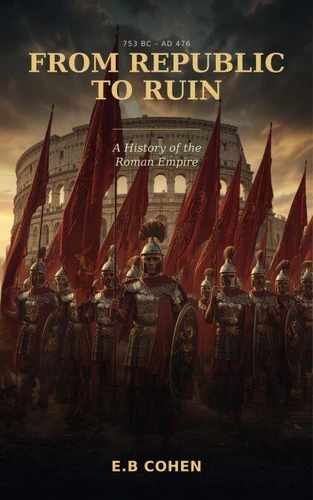
A small settlement of huts on the hills above the Tiber grew, over twelve centuries, into the master of the known world - and then, in the West, fell. From Republic to Ruin tells the whole story of Rome: how its power was won, held, transformed, and at last lost. E. B Cohen traces the full arc - the founding myth and the kings; the Republic that conquered an empire but could not govern it and tore itself apart in a century of civil war; Caesar, the Rubicon, and the Ides of March; Augustus and the long peace of the Principate; the Colosseum and the Five Good Emperors at the empire's height; the third-century crisis that nearly destroyed it; the rise of Christianity and the founding of Constantinople; and the slow unraveling of the West before the peoples it called barbarians, until in 476 the last emperor in Italy was quietly set aside.
But this is not only a story of emperors and battles. It pauses at the empire's height to show how Rome actually worked - its roads and aqueducts, its law and coinage, its legions on a frontier thousands of miles long, the vast population of slaves on whose labor it rested, and the texture of ordinary life in a city of a million people. Sober, vivid, and grounded in the ancient sources - Livy and Polybius, Tacitus and Suetonius, Cassius Dio and Ammianus - this is a single, authoritative history of the rise and fall of Rome, and of the question that has haunted the West ever since: why did Rome fall, and what did its fall mean?
A small settlement of huts on the hills above the Tiber grew, over twelve centuries, into the master of the known world - and then, in the West, fell. From Republic to Ruin tells the whole story of Rome: how its power was won, held, transformed, and at last lost. E. B Cohen traces the full arc - the founding myth and the kings; the Republic that conquered an empire but could not govern it and tore itself apart in a century of civil war; Caesar, the Rubicon, and the Ides of March; Augustus and the long peace of the Principate; the Colosseum and the Five Good Emperors at the empire's height; the third-century crisis that nearly destroyed it; the rise of Christianity and the founding of Constantinople; and the slow unraveling of the West before the peoples it called barbarians, until in 476 the last emperor in Italy was quietly set aside.
But this is not only a story of emperors and battles. It pauses at the empire's height to show how Rome actually worked - its roads and aqueducts, its law and coinage, its legions on a frontier thousands of miles long, the vast population of slaves on whose labor it rested, and the texture of ordinary life in a city of a million people. Sober, vivid, and grounded in the ancient sources - Livy and Polybius, Tacitus and Suetonius, Cassius Dio and Ammianus - this is a single, authoritative history of the rise and fall of Rome, and of the question that has haunted the West ever since: why did Rome fall, and what did its fall mean?

 , qui est-ce ?