Democracy is often understood through a simple definition: people choose their leaders through elections. But history has shown that elections alone do not guarantee freedom. A country may hold elections, maintain a constitution, operate a parliament, and still experience a gradual weakening of democratic accountability. The central question of this book is:How can a country continue to hold elections, maintain a constitution and call itself democratic while power gradually becomes less accountable?This book explores the complex relationship between democracy and power.
It examines how leaders gain public support, how institutions are tested, how narratives are created, how opponents are treated, how information is controlled, and how societies either resist or accept democratic decline. The purpose of this work is not to study one country, one ideology, or one political movement. Democracy must be examined through consistent principles. The same standards must apply to governments and oppositions, majorities and minorities, popular and unpopular leaders. The book follows a simple principle:No ideology owns democracy.
Democracy is not only a system of elections. It is a culture of accountability, institutional independence, human dignity, and peaceful transfer of power.
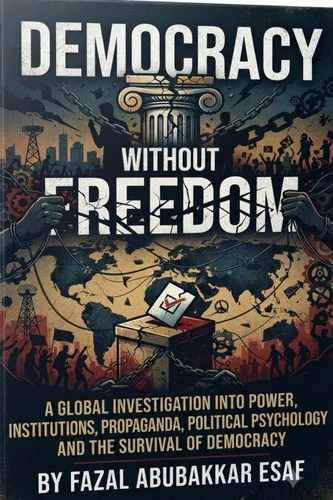
Democracy is often understood through a simple definition: people choose their leaders through elections. But history has shown that elections alone do not guarantee freedom. A country may hold elections, maintain a constitution, operate a parliament, and still experience a gradual weakening of democratic accountability. The central question of this book is:How can a country continue to hold elections, maintain a constitution and call itself democratic while power gradually becomes less accountable?This book explores the complex relationship between democracy and power.
It examines how leaders gain public support, how institutions are tested, how narratives are created, how opponents are treated, how information is controlled, and how societies either resist or accept democratic decline. The purpose of this work is not to study one country, one ideology, or one political movement. Democracy must be examined through consistent principles. The same standards must apply to governments and oppositions, majorities and minorities, popular and unpopular leaders. The book follows a simple principle:No ideology owns democracy.
Democracy is not only a system of elections. It is a culture of accountability, institutional independence, human dignity, and peaceful transfer of power.


 , qui est-ce ?