- Accueil /
- Fazal Abubakkar Esaf
Fazal Abubakkar Esaf

Dernière sortie
The Trace that Remains
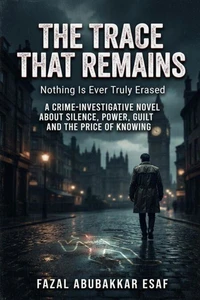
There are crimes that make noise. A gunshot. A broken window. A body discovered in the early hours of the morning. A police siren cutting through a sleeping neighborhood. And then there are crimes that make almost no sound at all. A payment changes hands. A phone call lasts thirty seconds. A witness decides not to speak. A file disappears from a cabinet. A business changes its name. Someone receives a promotion.
Someone else receives a warning. And somewhere, far away from the scene of the crime, an ordinary family continues eating dinner without knowing that its future has already been altered. The Trace That Remains begins in that silence. At the centre of the story is a man whose profession exists in the shadows. He is not the person who pulls the trigger. He is not necessarily the person who gives the order.
His task comes afterward. He makes problems disappear. He removes traces. He helps people return to ordinary life after extraordinary violence. He knows when to speak and, more importantly, when not to. But every profession has a cost. His is knowledge. The deeper he enters the machinery surrounding organised crime, money, influence, fear and political protection, the more he discovers that the visible crime is often only the smallest part of the story. Behind the crime is a relationship.
Behind the relationship is money. Behind the money is influence. Behind influence is fear. And behind fear is someone who has learned how to remain invisible. This is therefore not simply a crime novel. It is a story about the architecture of silence. It asks what happens when people discover that remaining silent may protect them today while destroying them tomorrow. It asks whether a person can spend years helping others bury the truth without eventually becoming part of that truth.
And it asks the question that follows every disappearance:What remains after everything has been removed?
Someone else receives a warning. And somewhere, far away from the scene of the crime, an ordinary family continues eating dinner without knowing that its future has already been altered. The Trace That Remains begins in that silence. At the centre of the story is a man whose profession exists in the shadows. He is not the person who pulls the trigger. He is not necessarily the person who gives the order.
His task comes afterward. He makes problems disappear. He removes traces. He helps people return to ordinary life after extraordinary violence. He knows when to speak and, more importantly, when not to. But every profession has a cost. His is knowledge. The deeper he enters the machinery surrounding organised crime, money, influence, fear and political protection, the more he discovers that the visible crime is often only the smallest part of the story. Behind the crime is a relationship.
Behind the relationship is money. Behind the money is influence. Behind influence is fear. And behind fear is someone who has learned how to remain invisible. This is therefore not simply a crime novel. It is a story about the architecture of silence. It asks what happens when people discover that remaining silent may protect them today while destroying them tomorrow. It asks whether a person can spend years helping others bury the truth without eventually becoming part of that truth.
And it asks the question that follows every disappearance:What remains after everything has been removed?
There are crimes that make noise. A gunshot. A broken window. A body discovered in the early hours of the morning. A police siren cutting through a sleeping neighborhood. And then there are crimes that make almost no sound at all. A payment changes hands. A phone call lasts thirty seconds. A witness decides not to speak. A file disappears from a cabinet. A business changes its name. Someone receives a promotion.
Someone else receives a warning. And somewhere, far away from the scene of the crime, an ordinary family continues eating dinner without knowing that its future has already been altered. The Trace That Remains begins in that silence. At the centre of the story is a man whose profession exists in the shadows. He is not the person who pulls the trigger. He is not necessarily the person who gives the order.
His task comes afterward. He makes problems disappear. He removes traces. He helps people return to ordinary life after extraordinary violence. He knows when to speak and, more importantly, when not to. But every profession has a cost. His is knowledge. The deeper he enters the machinery surrounding organised crime, money, influence, fear and political protection, the more he discovers that the visible crime is often only the smallest part of the story. Behind the crime is a relationship.
Behind the relationship is money. Behind the money is influence. Behind influence is fear. And behind fear is someone who has learned how to remain invisible. This is therefore not simply a crime novel. It is a story about the architecture of silence. It asks what happens when people discover that remaining silent may protect them today while destroying them tomorrow. It asks whether a person can spend years helping others bury the truth without eventually becoming part of that truth.
And it asks the question that follows every disappearance:What remains after everything has been removed?
Someone else receives a warning. And somewhere, far away from the scene of the crime, an ordinary family continues eating dinner without knowing that its future has already been altered. The Trace That Remains begins in that silence. At the centre of the story is a man whose profession exists in the shadows. He is not the person who pulls the trigger. He is not necessarily the person who gives the order.
His task comes afterward. He makes problems disappear. He removes traces. He helps people return to ordinary life after extraordinary violence. He knows when to speak and, more importantly, when not to. But every profession has a cost. His is knowledge. The deeper he enters the machinery surrounding organised crime, money, influence, fear and political protection, the more he discovers that the visible crime is often only the smallest part of the story. Behind the crime is a relationship.
Behind the relationship is money. Behind the money is influence. Behind influence is fear. And behind fear is someone who has learned how to remain invisible. This is therefore not simply a crime novel. It is a story about the architecture of silence. It asks what happens when people discover that remaining silent may protect them today while destroying them tomorrow. It asks whether a person can spend years helping others bury the truth without eventually becoming part of that truth.
And it asks the question that follows every disappearance:What remains after everything has been removed?