Dernière sortie
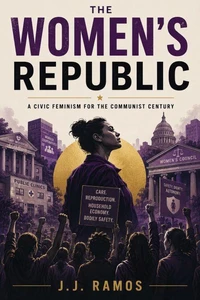
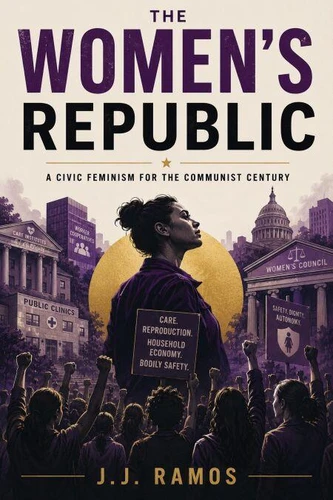
The Women's Republic: A Civic Feminism for the Communist Century
Institutional form that the constituency owns and governs. The book argues that the republic women need is not a metaphor but a political form: female-majority governance of the institutions that touch female lives, backed by ownership, law, and organized constituency. The book is in four parts. Part I redefines "republic" as a working political form, names the four domains a women's republic would govern (care, reproduction, household economy, bodily safety), and makes the civic-feminist case against the cultural, theoretical, and identity registers.
Part II is a field guide to the four domains: who owns the buildings now, who does the labor, where the governance gap sits, what female-majority governance of each domain would mean concretely. Part III walks the four mechanisms: ownership (cooperative and public models), law (the statutes that exist and the enforcement vacuum under them), constituency (the organized political bloc that has not yet formed), and enforcement (the central feminist problem of the century).
Part IV is the constructive program: the existing partial models (Iceland, Rwanda, the Nordic care infrastructure, the Domestic Workers Bills of Rights), the coalition that has to form, the obstacles that will be encountered, and the institutional form, named. Drawing on Hannah Arendt, Susan Moller Okin, Catharine MacKinnon, Joan Tronto, Ai-jen Poo, Kate Manne, Caroline Criado Perez, Steven Levitsky and Daniel Ziblatt, Ramos hands the reader the institutional vocabulary of the next century of feminist work.
Part II is a field guide to the four domains: who owns the buildings now, who does the labor, where the governance gap sits, what female-majority governance of each domain would mean concretely. Part III walks the four mechanisms: ownership (cooperative and public models), law (the statutes that exist and the enforcement vacuum under them), constituency (the organized political bloc that has not yet formed), and enforcement (the central feminist problem of the century).
Part IV is the constructive program: the existing partial models (Iceland, Rwanda, the Nordic care infrastructure, the Domestic Workers Bills of Rights), the coalition that has to form, the obstacles that will be encountered, and the institutional form, named. Drawing on Hannah Arendt, Susan Moller Okin, Catharine MacKinnon, Joan Tronto, Ai-jen Poo, Kate Manne, Caroline Criado Perez, Steven Levitsky and Daniel Ziblatt, Ramos hands the reader the institutional vocabulary of the next century of feminist work.