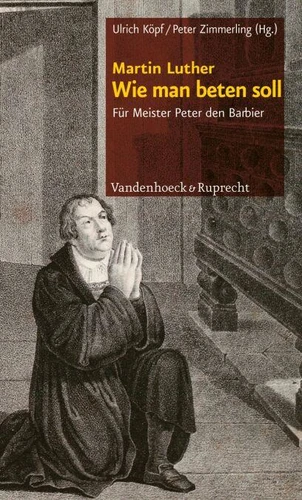
Wie man beten soll. Für Meister Peter den Barbier
Par : , ,Formats :
Disponible dans votre compte client Decitre ou Furet du Nord dès validation de votre commande. Le format PDF est :
- Compatible avec une lecture sur My Vivlio (smartphone, tablette, ordinateur)
- Compatible avec une lecture sur liseuses Vivlio
- Pour les liseuses autres que Vivlio, vous devez utiliser le logiciel Adobe Digital Edition. Non compatible avec la lecture sur les liseuses Kindle, Remarkable et Sony
 , qui est-ce ?
Notre partenaire de plateforme de lecture numérique où vous retrouverez l'ensemble de vos ebooks gratuitement
Pour en savoir plus sur nos ebooks, consultez notre aide en ligne ici
C'est si simple ! Lisez votre ebook avec l'app Vivlio sur votre tablette, mobile ou ordinateur :

- Nombre de pages64
- FormatPDF
- ISBN978-3-647-56009-0
- EAN9783647560090
- Date de parution17/08/2011
- Protection num.pas de protection
- Taille388 Ko
- Infos supplémentairespdf
- ÉditeurVandenhoeck & Ruprecht
Résumé
Martin Luther´s work "How to Pray" provides, like no other of his many works, deep insight into the personal spirituality of the great reformer. Using the example of prayer Luther reveals how piety can be lived out to the fullest. This work is also an excellent example of simplicity and clarity. He wrote it for a craftsman - his own barber Master Peter. In preparation of the upcoming 500th anniversary of Reformation in 2017, the Protestant Church in Germany has christened the coming decade the Luther Decade.
This new edition of Martin Luther´s work "How to Pray" from 1535 is edited by Ulrich Köpf and Peter Zimmerling, who see it as a contribution to provide a broad audience with insight into the beliefs and thoughts of the great reformer, something many Protestants today have lost sight of. In only a few pages Luther develops an entire course on the subject of prayer. Here he tries to teach a layperson, who apparently has been having trouble praying, how to carry out this act and why.
Luther assumes that faith too requires practice if it is not to shrivel and fade. In this sense he sees his words as a correction to newer Protestant beliefs that salvation results solely from grace, making spiritual practice unnecessary. To that Luther replies: Prayer as part of Protestant spirituality is appropriate within the sphere of freedom. Praying prearranged texts serves the practiced supplicant as a sort of "match" to light the fire of one´s heart and enable that person to proceed to more freestyled prayer.
The theological introduction by Zimmerling as well as the Foreword by Köpf help the reader to better grasp the words of Luther.
This new edition of Martin Luther´s work "How to Pray" from 1535 is edited by Ulrich Köpf and Peter Zimmerling, who see it as a contribution to provide a broad audience with insight into the beliefs and thoughts of the great reformer, something many Protestants today have lost sight of. In only a few pages Luther develops an entire course on the subject of prayer. Here he tries to teach a layperson, who apparently has been having trouble praying, how to carry out this act and why.
Luther assumes that faith too requires practice if it is not to shrivel and fade. In this sense he sees his words as a correction to newer Protestant beliefs that salvation results solely from grace, making spiritual practice unnecessary. To that Luther replies: Prayer as part of Protestant spirituality is appropriate within the sphere of freedom. Praying prearranged texts serves the practiced supplicant as a sort of "match" to light the fire of one´s heart and enable that person to proceed to more freestyled prayer.
The theological introduction by Zimmerling as well as the Foreword by Köpf help the reader to better grasp the words of Luther.
A propos de Martin Luther

0,99 €