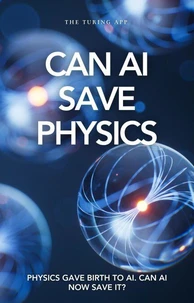
This book is a Weekend Pocketbook on Everything You Should Know About the Future of Particle Physics, the moment when humanity's most powerful machines have found the Higgs boson, but not the next great clue. For decades, particle physics have tried to build a bigger machine, smash particles harder, discover something new. Then came the Large Hadron Collider (LHC), the Higgs boson, and the silence that followed.
No supersymmetry. No dark matter particle. No obvious crack in the Standard Model. So should we build an even bigger machine?This book explores the dream and controversy of the Future Circular Collider (FCC): a 100-kilometer ring that could probe nature at energies far beyond today's reach. Would it reveal hidden particles, explain dark matter, or show why matter survived after the Big Bang? Or could it become the most expensive search for nothing in scientific history?What if the next breakthrough does not come from a larger tunnel, but from smarter tools? Artificial intelligence is already helping physicists scan impossible amounts of data, tune machines, run simulations, and notice patterns humans might miss.
Do we need a bigger collider, a better algorithm, or a completely new way to ask the universe what it is made of?
This book is a Weekend Pocketbook on Everything You Should Know About the Future of Particle Physics, the moment when humanity's most powerful machines have found the Higgs boson, but not the next great clue. For decades, particle physics have tried to build a bigger machine, smash particles harder, discover something new. Then came the Large Hadron Collider (LHC), the Higgs boson, and the silence that followed.
No supersymmetry. No dark matter particle. No obvious crack in the Standard Model. So should we build an even bigger machine?This book explores the dream and controversy of the Future Circular Collider (FCC): a 100-kilometer ring that could probe nature at energies far beyond today's reach. Would it reveal hidden particles, explain dark matter, or show why matter survived after the Big Bang? Or could it become the most expensive search for nothing in scientific history?What if the next breakthrough does not come from a larger tunnel, but from smarter tools? Artificial intelligence is already helping physicists scan impossible amounts of data, tune machines, run simulations, and notice patterns humans might miss.
Do we need a bigger collider, a better algorithm, or a completely new way to ask the universe what it is made of?

 , qui est-ce ?