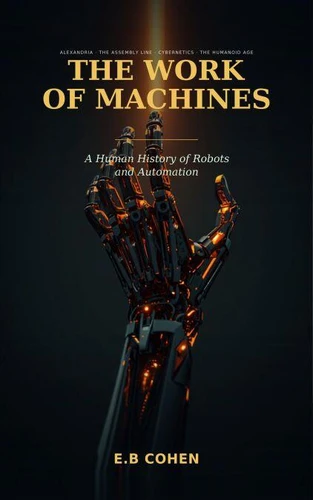
For four thousand years, human beings have tried to build machines that work so we do not have to. The dream is as old as the water clocks of Alexandria and the clockwork ducks of the Enlightenment; it runs through the Jacquard loom, Henry Ford's moving line, and the four-thousand-pound robot arm that first stacked hot metal at a New Jersey car plant in 1961. It reaches its strange climax in our own decade, as humanoid robots begin to walk onto factory floors. The Work of Machines tells that whole story as one sweeping narrative.
Here is Karel Capek, who gave us the word "robot" from the Czech for forced labor; Norbert Wiener, who named the science of control and warned us where it might lead; George Devol and Joseph Engelberger, who turned a cocktail-party joke into the first industrial robot; Rodney Brooks, who taught robots to think like insects; and the engineers racing today to solve the last, hardest problem of all - a machine that can pick up a strange object it has never seen. E.
B Cohen braids invention and anxiety, breakthrough and blunder, into a single readable history - and asks, honestly, the question every generation since the Luddites has faced: when the machines do our work, what work is left for us?
For four thousand years, human beings have tried to build machines that work so we do not have to. The dream is as old as the water clocks of Alexandria and the clockwork ducks of the Enlightenment; it runs through the Jacquard loom, Henry Ford's moving line, and the four-thousand-pound robot arm that first stacked hot metal at a New Jersey car plant in 1961. It reaches its strange climax in our own decade, as humanoid robots begin to walk onto factory floors. The Work of Machines tells that whole story as one sweeping narrative.
Here is Karel Capek, who gave us the word "robot" from the Czech for forced labor; Norbert Wiener, who named the science of control and warned us where it might lead; George Devol and Joseph Engelberger, who turned a cocktail-party joke into the first industrial robot; Rodney Brooks, who taught robots to think like insects; and the engineers racing today to solve the last, hardest problem of all - a machine that can pick up a strange object it has never seen. E.
B Cohen braids invention and anxiety, breakthrough and blunder, into a single readable history - and asks, honestly, the question every generation since the Luddites has faced: when the machines do our work, what work is left for us?


 , qui est-ce ?