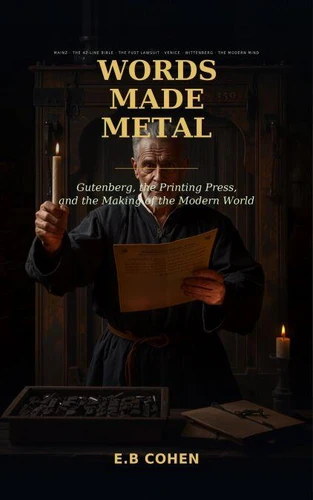
For a thousand years, a book was a rare and costly thing, copied one letter at a time by hand, so that a single Bible could take a scribe a year and cost as much as a small farm. Then, around 1450, in the Rhineland city of Mainz, a goldsmith named Johannes Gutenberg fitted together a cluster of ordinary crafts - a metal-casting mould, an oily new ink, a wine-press, and cheap rag paper - into one machine that could stamp out identical words by the thousand.
Within fifty years his invention had reached more than two hundred European towns and printed over twenty million books. Nothing was ever the same again. E. B Cohen tells the whole sweep of that transformation. Here is the vanished world of the monastic scriptorium and the value of a handmade page; the Chinese and Korean printers who cast movable type centuries before Gutenberg; the exact, ingenious mechanics of the punch, the matrix, the hand mould, and the press, explained so that anyone can picture them; the human drama of the workshop, and the ruinous lawsuit in which Gutenberg's own financier, Johann Fust, seized the enterprise on the eve of its triumph; and the astonishing chain reaction that followed - Luther's pamphlets and the Reformation, the diagrams and star charts of the Scientific Revolution, the fixing of national languages, the birth of the newspaper, the first battles over censorship and copyright.
Even-handed and vivid, this is the story of how a single machine changed what human beings could know, believe, and argue about - and why, in an age of screens and networks, we are living through a second Gutenberg moment whose outcome is still being decided.
For a thousand years, a book was a rare and costly thing, copied one letter at a time by hand, so that a single Bible could take a scribe a year and cost as much as a small farm. Then, around 1450, in the Rhineland city of Mainz, a goldsmith named Johannes Gutenberg fitted together a cluster of ordinary crafts - a metal-casting mould, an oily new ink, a wine-press, and cheap rag paper - into one machine that could stamp out identical words by the thousand.
Within fifty years his invention had reached more than two hundred European towns and printed over twenty million books. Nothing was ever the same again. E. B Cohen tells the whole sweep of that transformation. Here is the vanished world of the monastic scriptorium and the value of a handmade page; the Chinese and Korean printers who cast movable type centuries before Gutenberg; the exact, ingenious mechanics of the punch, the matrix, the hand mould, and the press, explained so that anyone can picture them; the human drama of the workshop, and the ruinous lawsuit in which Gutenberg's own financier, Johann Fust, seized the enterprise on the eve of its triumph; and the astonishing chain reaction that followed - Luther's pamphlets and the Reformation, the diagrams and star charts of the Scientific Revolution, the fixing of national languages, the birth of the newspaper, the first battles over censorship and copyright.
Even-handed and vivid, this is the story of how a single machine changed what human beings could know, believe, and argue about - and why, in an age of screens and networks, we are living through a second Gutenberg moment whose outcome is still being decided.


 , qui est-ce ?