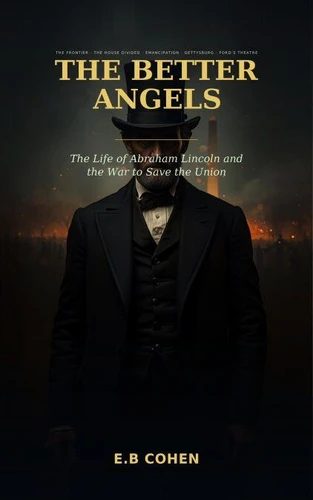
There are more books about Abraham Lincoln than about any other American, and it is easy for the living man to vanish behind the marble. This book finds him again. It follows a barefoot boy who walked miles to borrow books out of a one-room cabin, through the mud of the Illinois circuit and the fire of the Lincoln-Douglas debates, into the White House and a war that killed three-quarters of a million people.
E. B Cohen tells the whole story: the frontier grief that shaped him; the melancholy that ran under his humor like a river under ice; the marriage that history has caricatured; the cabinet of rivals he bent to his purpose; the generals who would not fight and the one who finally did; the Emancipation Proclamation and the four million lives it touched; the two minutes at Gettysburg that quietly rewrote the nation around the promise that all men are created equal; and the Good Friday in 1865 when it all came to an end at Ford's Theatre.
Even-handed and unflinching, this is a portrait of the greatness and the limits alike - the man who saved self-government and suspended a citizen's ancient rights to do it; who freed a people he had once struggled to imagine as equals; who bore private and national grief in the same worn face. It is the definitive single-volume life of the president who asked a bleeding country to listen, once more, to the better angels of its nature.
There are more books about Abraham Lincoln than about any other American, and it is easy for the living man to vanish behind the marble. This book finds him again. It follows a barefoot boy who walked miles to borrow books out of a one-room cabin, through the mud of the Illinois circuit and the fire of the Lincoln-Douglas debates, into the White House and a war that killed three-quarters of a million people.
E. B Cohen tells the whole story: the frontier grief that shaped him; the melancholy that ran under his humor like a river under ice; the marriage that history has caricatured; the cabinet of rivals he bent to his purpose; the generals who would not fight and the one who finally did; the Emancipation Proclamation and the four million lives it touched; the two minutes at Gettysburg that quietly rewrote the nation around the promise that all men are created equal; and the Good Friday in 1865 when it all came to an end at Ford's Theatre.
Even-handed and unflinching, this is a portrait of the greatness and the limits alike - the man who saved self-government and suspended a citizen's ancient rights to do it; who freed a people he had once struggled to imagine as equals; who bore private and national grief in the same worn face. It is the definitive single-volume life of the president who asked a bleeding country to listen, once more, to the better angels of its nature.


 , qui est-ce ?