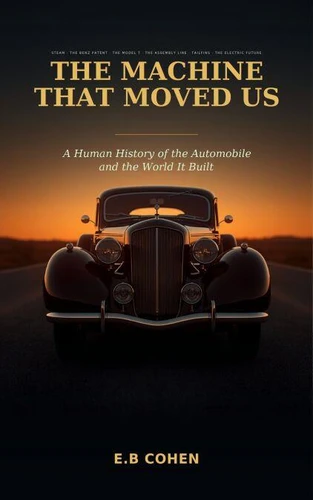
For all of human history, going anywhere by land meant muscle - the horse, the ox, and the tired human foot. Then, in a workshop on the German Rhine in 1886, a frustrated engineer named Karl Benz fitted a small gasoline engine to a three-wheeled carriage, and the world began to change faster than anyone could have imagined. Within a single lifetime the automobile would pave the continents, invent the suburb and the commute, remake the family holiday and the teenage rite of passage, redraw the map of where people live and work, and quietly rewrite the rules of the street itself.
E. B Cohen tells the whole sweep of that transformation in one gripping volume. Here is the filthy, horse-choked city the car was sold to clean up; the long convergence of inventions - the engine, the tyre, the fuel, the road - that no single genius created; Bertha Benz's audacious sixty-mile drive that proved the machine could work; Henry Ford's moving assembly line, which cut the time to build a car from twelve hours to ninety-three minutes and turned a rich man's toy into the possession of the many; the golden age of chrome and tailfins and its long shadow of smog, leaded fuel, and a tide of road deaths that forced a reckoning; the quiet Japanese revolution that humbled Detroit; and the electric, connected, and self-driving turn of our own restless decade.
Even-handed and vivid, this is the story of the most liberating and most demanding machine human beings have ever built - and of why, in an age of climate reckoning and autonomous promise, the road ahead is still being drawn.
For all of human history, going anywhere by land meant muscle - the horse, the ox, and the tired human foot. Then, in a workshop on the German Rhine in 1886, a frustrated engineer named Karl Benz fitted a small gasoline engine to a three-wheeled carriage, and the world began to change faster than anyone could have imagined. Within a single lifetime the automobile would pave the continents, invent the suburb and the commute, remake the family holiday and the teenage rite of passage, redraw the map of where people live and work, and quietly rewrite the rules of the street itself.
E. B Cohen tells the whole sweep of that transformation in one gripping volume. Here is the filthy, horse-choked city the car was sold to clean up; the long convergence of inventions - the engine, the tyre, the fuel, the road - that no single genius created; Bertha Benz's audacious sixty-mile drive that proved the machine could work; Henry Ford's moving assembly line, which cut the time to build a car from twelve hours to ninety-three minutes and turned a rich man's toy into the possession of the many; the golden age of chrome and tailfins and its long shadow of smog, leaded fuel, and a tide of road deaths that forced a reckoning; the quiet Japanese revolution that humbled Detroit; and the electric, connected, and self-driving turn of our own restless decade.
Even-handed and vivid, this is the story of the most liberating and most demanding machine human beings have ever built - and of why, in an age of climate reckoning and autonomous promise, the road ahead is still being drawn.


 , qui est-ce ?