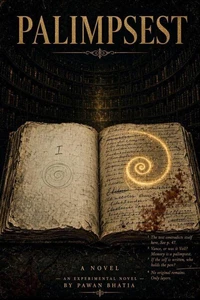
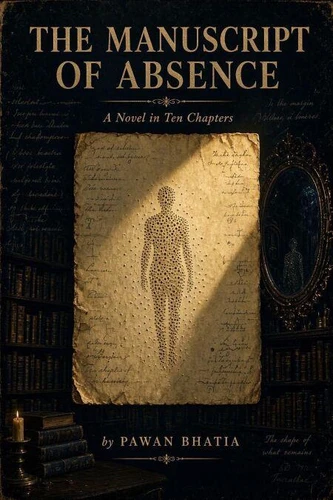
The Manuscript of Absence is a metaphysical labyrinth disguised as a novel-a work that actively resists conventional reading. When archivist Aldric Vane investigates the disappearance of scholar Elias Voss, he discovers a perforated vellum folio whose holes form not words but a map. The map leads not to a physical location, but to a state beyond identity. Joined by the razor-sharp Lady Cerise, the ponderous Dr.
Thorne, and the enigmatic Curator, Vane uncovers Voss's unpublished treatise, On the Grammar of Self-Erasure, which argues that the "I" is a grammatical cage. Meaning, Voss insists, resides not in text but in margins, not in words but in the silences between them. The ritual of transformation requires a reversed litany of pronouns, a warped Venetian mirror, and a box of sand that contains the self.
As each witness performs the ritual, they vanish-not into death, but into a transferable absence, a presence that can be passed from one person to the next, a curse that is also a gift. An acrostic hidden across chapters spells: "THE KEY IS NOT IN THE TEXT BUT IN THE MARGIN." The marginal notes, written in pale blue ink, reveal the final instruction: "The reader is the text."This is not a book to be consumed, but a ritual to be performed-read aloud, before a mirror, and reread until you become what you have read.
It is a door that opens inward, inviting you to dissolve into the spaces between words.
The Manuscript of Absence is a metaphysical labyrinth disguised as a novel-a work that actively resists conventional reading. When archivist Aldric Vane investigates the disappearance of scholar Elias Voss, he discovers a perforated vellum folio whose holes form not words but a map. The map leads not to a physical location, but to a state beyond identity. Joined by the razor-sharp Lady Cerise, the ponderous Dr.
Thorne, and the enigmatic Curator, Vane uncovers Voss's unpublished treatise, On the Grammar of Self-Erasure, which argues that the "I" is a grammatical cage. Meaning, Voss insists, resides not in text but in margins, not in words but in the silences between them. The ritual of transformation requires a reversed litany of pronouns, a warped Venetian mirror, and a box of sand that contains the self.
As each witness performs the ritual, they vanish-not into death, but into a transferable absence, a presence that can be passed from one person to the next, a curse that is also a gift. An acrostic hidden across chapters spells: "THE KEY IS NOT IN THE TEXT BUT IN THE MARGIN." The marginal notes, written in pale blue ink, reveal the final instruction: "The reader is the text."This is not a book to be consumed, but a ritual to be performed-read aloud, before a mirror, and reread until you become what you have read.
It is a door that opens inward, inviting you to dissolve into the spaces between words.

 , qui est-ce ?