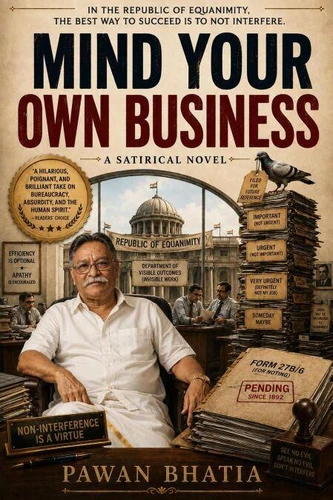
When unemployed Kiran Sharma receives a surprise appointment as Minister for Civic Sanity, she enters a bureaucracy designed to ensure nothing ever changes. The Republic of Equanimity runs on a single principle: Mind Your Own Business. Citizens eat grey nutrient paste, queue for jobs that don't exist, and are fined for speaking to neighbors. But Kiran refuses to look away. When her proposal to distribute medicine to the neglected northern provinces is rejected by the Prime Minister, she discovers a loophole.
With help from Amara, a veteran clerk, she uses the Department of Superfluous Statistics to file paperwork that no one reviews-and begins smuggling medical supplies through an underground network. As the network expands, so does the resistance. A former advisor, Marcus Thorne, uses the bureaucracy's own machinery against Kiran-freezing funds, launching investigations, and eventually having her kidnapped.
But Kiran's allies-Elena, a secret investigator, and Ms. Okafor, who has kept an eleven-year ledger of bureaucratic secrets-rescue her. Thorne is tried and imprisoned. Kiran becomes Minister for Health, then Prime Minister, transforming Equanimity over decades. The grey paste is abolished, windows are enlarged, and the Non-Interference Act is repealed. But she never forgets the lesson: the system doesn't stay fixed.
It must be kept fixed, every day, by people who refuse to look away. In her memoir, she writes: "Every reformer thinks they're changing the system. But eventually, the reform becomes another department, and someone else has to come along and overthrow you. That's the tragedy of governance. But it's also the hope."
When unemployed Kiran Sharma receives a surprise appointment as Minister for Civic Sanity, she enters a bureaucracy designed to ensure nothing ever changes. The Republic of Equanimity runs on a single principle: Mind Your Own Business. Citizens eat grey nutrient paste, queue for jobs that don't exist, and are fined for speaking to neighbors. But Kiran refuses to look away. When her proposal to distribute medicine to the neglected northern provinces is rejected by the Prime Minister, she discovers a loophole.
With help from Amara, a veteran clerk, she uses the Department of Superfluous Statistics to file paperwork that no one reviews-and begins smuggling medical supplies through an underground network. As the network expands, so does the resistance. A former advisor, Marcus Thorne, uses the bureaucracy's own machinery against Kiran-freezing funds, launching investigations, and eventually having her kidnapped.
But Kiran's allies-Elena, a secret investigator, and Ms. Okafor, who has kept an eleven-year ledger of bureaucratic secrets-rescue her. Thorne is tried and imprisoned. Kiran becomes Minister for Health, then Prime Minister, transforming Equanimity over decades. The grey paste is abolished, windows are enlarged, and the Non-Interference Act is repealed. But she never forgets the lesson: the system doesn't stay fixed.
It must be kept fixed, every day, by people who refuse to look away. In her memoir, she writes: "Every reformer thinks they're changing the system. But eventually, the reform becomes another department, and someone else has to come along and overthrow you. That's the tragedy of governance. But it's also the hope."


 , qui est-ce ?