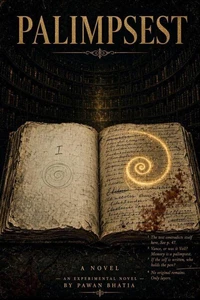
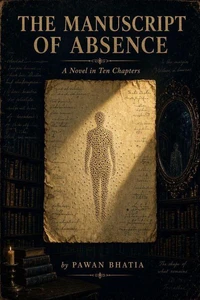
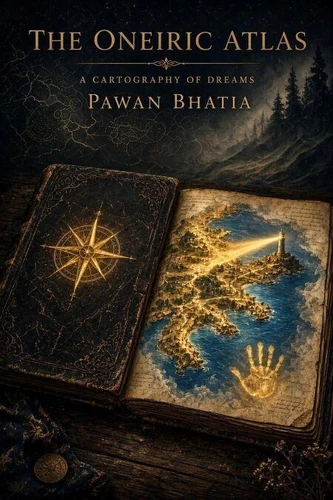
"The Oneiric Atlas" is a 120, 000-word novel blending magical realism and psychological drama. It follows Ezra Vance, a grieving architectural draughtsman, who discovers a hidden atlas in his comatose wife Lyra's study three years after her accident. The Atlas, warm and breathing like a living entity, contains shifting dream-maps-Formentera, a spiral city, deserts of grief, and dark forests-with ghost-sentences guiding him.
Lyra's consciousness is embedded in its vellum, fading due to the Null-Topographer, a force of forgetting that smooths emotional peaks. Ezra has thirty nights to reach the "Source"-the original dream of the crash-to wake her. Guided by Dr. Silas Meridian, an oneirologist, Ezra repeatedly descends, navigating treacherous terrains that mirror his regrets. His body transforms: veins trace river systems, his face erodes, becoming part of the map.
He confronts the Null-Topographer, which reveals itself as Lyra's protective shield against trauma. Ezra learns that burning the Atlas would free her but erase her memories. He discovers the Source is not a dream but a real-world memory-their first kiss in Barcelona. By sacrificing that memory, he restores the Source and pulls Lyra back. They awaken in the hospital, embrace, and begin healing. The Atlas is burned, but ghost-sentences persist: "We are not lost.
We are mapped." Silas preserves a final vellum fragment. The epilogue shows an archivist finding it, the words glowing faintly. Themes include love's endurance, the palimpsest of dreams, courage to face trauma, and the cartography of grief. The novel explores how memories shape identity and how mapping inner landscapes can lead to recovery. It ends with Ezra and Lyra walking together, refusing erasure, their love inscribed in the deep geometry of dreams.
The narrative employs acrostics and marginalia to evoke a palimpsest reading experience, inviting readers to explore their own interior geographies. Ultimately, the story affirms that love can survive even the erasure of memory, and that we are never truly lost as long as we are mapped in someone's heart.
"The Oneiric Atlas" is a 120, 000-word novel blending magical realism and psychological drama. It follows Ezra Vance, a grieving architectural draughtsman, who discovers a hidden atlas in his comatose wife Lyra's study three years after her accident. The Atlas, warm and breathing like a living entity, contains shifting dream-maps-Formentera, a spiral city, deserts of grief, and dark forests-with ghost-sentences guiding him.
Lyra's consciousness is embedded in its vellum, fading due to the Null-Topographer, a force of forgetting that smooths emotional peaks. Ezra has thirty nights to reach the "Source"-the original dream of the crash-to wake her. Guided by Dr. Silas Meridian, an oneirologist, Ezra repeatedly descends, navigating treacherous terrains that mirror his regrets. His body transforms: veins trace river systems, his face erodes, becoming part of the map.
He confronts the Null-Topographer, which reveals itself as Lyra's protective shield against trauma. Ezra learns that burning the Atlas would free her but erase her memories. He discovers the Source is not a dream but a real-world memory-their first kiss in Barcelona. By sacrificing that memory, he restores the Source and pulls Lyra back. They awaken in the hospital, embrace, and begin healing. The Atlas is burned, but ghost-sentences persist: "We are not lost.
We are mapped." Silas preserves a final vellum fragment. The epilogue shows an archivist finding it, the words glowing faintly. Themes include love's endurance, the palimpsest of dreams, courage to face trauma, and the cartography of grief. The novel explores how memories shape identity and how mapping inner landscapes can lead to recovery. It ends with Ezra and Lyra walking together, refusing erasure, their love inscribed in the deep geometry of dreams.
The narrative employs acrostics and marginalia to evoke a palimpsest reading experience, inviting readers to explore their own interior geographies. Ultimately, the story affirms that love can survive even the erasure of memory, and that we are never truly lost as long as we are mapped in someone's heart.


 , qui est-ce ?