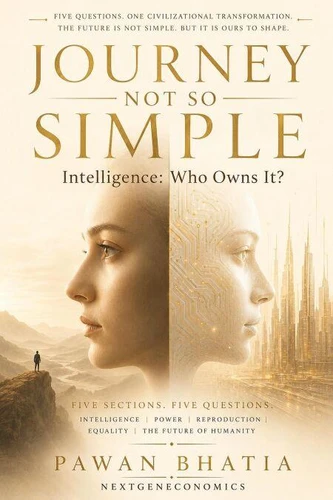
This book examines five interconnected questions about a civilizational transformation driven by converging technologies. First, it asks whether intelligence will remain uniquely human. As AI systems grow more capable, the biological substrate of intelligence is no longer exclusive-machines can now perform cognitive tasks once requiring trained human minds. Second, it explores intelligence as a continuum, found everywhere from slime molds to silicon, challenging human exceptionalism.
Third, it interrogates what happens to economics when intelligence and physical productivity become abundant, potentially rendering scarcity-based systems obsolete. Fourth, it confronts existential risks: alignment, control, race dynamics, and governance challenges as intelligence becomes more powerful than any individual. Finally, it examines how technology is destabilizing the biological foundations of society-physical strength, reproduction, and gender roles.
The book argues these transformations are not separate but form a unified upheaval of the human condition. It offers no easy answers but insists these questions demand urgent, thoughtful engagement. The future isn't predetermined; it will be shaped by choices made now, in laboratories, legislatures, and daily life. The journey requires courage, humility, and openness-not to find comfort, but to think clearly about a world that will not wait for consensus.
Intelligence, economics, survival, and identity all hang in the balance.
This book examines five interconnected questions about a civilizational transformation driven by converging technologies. First, it asks whether intelligence will remain uniquely human. As AI systems grow more capable, the biological substrate of intelligence is no longer exclusive-machines can now perform cognitive tasks once requiring trained human minds. Second, it explores intelligence as a continuum, found everywhere from slime molds to silicon, challenging human exceptionalism.
Third, it interrogates what happens to economics when intelligence and physical productivity become abundant, potentially rendering scarcity-based systems obsolete. Fourth, it confronts existential risks: alignment, control, race dynamics, and governance challenges as intelligence becomes more powerful than any individual. Finally, it examines how technology is destabilizing the biological foundations of society-physical strength, reproduction, and gender roles.
The book argues these transformations are not separate but form a unified upheaval of the human condition. It offers no easy answers but insists these questions demand urgent, thoughtful engagement. The future isn't predetermined; it will be shaped by choices made now, in laboratories, legislatures, and daily life. The journey requires courage, humility, and openness-not to find comfort, but to think clearly about a world that will not wait for consensus.
Intelligence, economics, survival, and identity all hang in the balance.


 , qui est-ce ?