SOLDES
Jusqu'à -70% sur une sélection d'articles*

Nouveauté
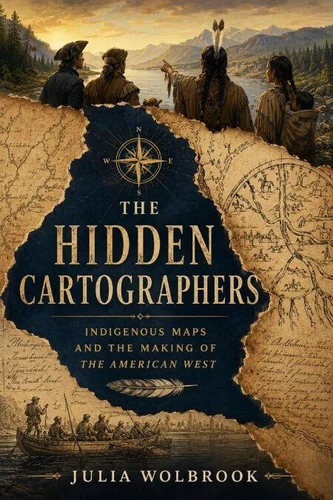
The Hidden Cartographers Indigenous Maps and the Making of the American West
Par :Formats :
Disponible dans votre compte client Decitre ou Furet du Nord dès validation de votre commande. Le format ePub est :
- Compatible avec une lecture sur My Vivlio (smartphone, tablette, ordinateur)
- Compatible avec une lecture sur liseuses Vivlio
- Pour les liseuses autres que Vivlio, vous devez utiliser le logiciel Adobe Digital Edition. Non compatible avec la lecture sur les liseuses Kindle, Remarkable et Sony
 , qui est-ce ?
Notre partenaire de plateforme de lecture numérique où vous retrouverez l'ensemble de vos ebooks gratuitement
Pour en savoir plus sur nos ebooks, consultez notre aide en ligne ici
C'est si simple ! Lisez votre ebook avec l'app Vivlio sur votre tablette, mobile ou ordinateur :

- FormatePub
- ISBN8235466159
- EAN9798235466159
- Date de parution16/05/2026
- Protection num.pas de protection
- Infos supplémentairesepub
- ÉditeurIoakim Ioakim
Résumé
In the official histories of the American West, maps have long been treated as neutral artifacts, lines on paper that merely recorded discovery, ownership, and expansion. But The Hidden Cartographers: Indigenous Maps and the Making of the American West reveals a far more complex truth: the land was never unmapped; it was only misread. This groundbreaking work re-centers the West not as an empty frontier awaiting inscription, but as a richly charted world already known through Indigenous systems of geography, memory, and movement.
Rivers were not boundaries but living routes; mountains were not obstacles but story-markers; entire landscapes were encoded with meaning long before European cartography imposed its grids. Through a sweeping blend of historical reconstruction, cultural analysis, and visual interpretation, the book uncovers how Indigenous mapping traditions shaped navigation, diplomacy, trade, and survival, while subtly influencing the very maps that would later define conquest.
These were not maps in the Western sense, but sophisticated spatial languages: drawn in sand, stitched into textiles, remembered in song, and inscribed in ceremony. At its heart, The Hidden Cartographers is an act of restoration. It challenges readers to see the American West not as a blank slate filled in by explorers, but as a deeply layered, already-interpreted world where knowledge of place was precise, relational, and enduring.
By bringing these suppressed geographies into view, the book redraws more than borders; it redraws understanding itself.
Rivers were not boundaries but living routes; mountains were not obstacles but story-markers; entire landscapes were encoded with meaning long before European cartography imposed its grids. Through a sweeping blend of historical reconstruction, cultural analysis, and visual interpretation, the book uncovers how Indigenous mapping traditions shaped navigation, diplomacy, trade, and survival, while subtly influencing the very maps that would later define conquest.
These were not maps in the Western sense, but sophisticated spatial languages: drawn in sand, stitched into textiles, remembered in song, and inscribed in ceremony. At its heart, The Hidden Cartographers is an act of restoration. It challenges readers to see the American West not as a blank slate filled in by explorers, but as a deeply layered, already-interpreted world where knowledge of place was precise, relational, and enduring.
By bringing these suppressed geographies into view, the book redraws more than borders; it redraws understanding itself.
A propos de Julia Wolbrook







2,99 €