SOLDES
Jusqu'à -70% sur une sélection d'articles*

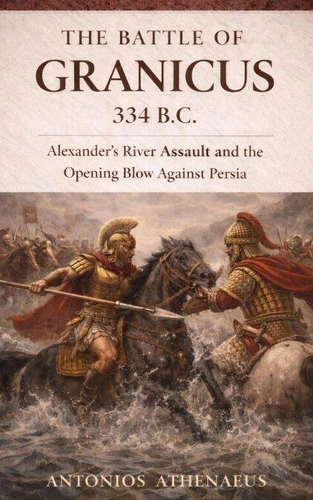
The Battle of Granicus 334 B.C.: Alexander’s River Assault and the Opening Blow Against Persia. Epic Battles of Ancient History, #9
Par :Formats :
Disponible dans votre compte client Decitre ou Furet du Nord dès validation de votre commande. Le format ePub est :
- Compatible avec une lecture sur My Vivlio (smartphone, tablette, ordinateur)
- Compatible avec une lecture sur liseuses Vivlio
- Pour les liseuses autres que Vivlio, vous devez utiliser le logiciel Adobe Digital Edition. Non compatible avec la lecture sur les liseuses Kindle, Remarkable et Sony
 , qui est-ce ?
Notre partenaire de plateforme de lecture numérique où vous retrouverez l'ensemble de vos ebooks gratuitement
Pour en savoir plus sur nos ebooks, consultez notre aide en ligne ici
C'est si simple ! Lisez votre ebook avec l'app Vivlio sur votre tablette, mobile ou ordinateur :

- FormatePub
- ISBN8231283569
- EAN9798231283569
- Date de parution24/03/2026
- Protection num.pas de protection
- Infos supplémentairesepub
- ÉditeurWalzone Press
Résumé
At the Granicus, the campaign in Asia ceased to be an intention and became a fact of war. In 334 B. C., Alexander III of Macedon did not merely enter Persian territory; he forced the empire to contest his advance at the first major barrier on the invasion route. At the Granicus River, the western satraps sought to halt the invasion before it gathered momentum, using cavalry shock at the riverbank and depth behind the line to break the Macedonian assault before a foothold could be secured.
This book examines the Battle of Granicus not as a reckless charge by a young king, but as a calculated act of operational violence. It was the first great test of Alexander's method: whether a commander could force a defended river crossing, absorb the shock of close combat under adverse conditions, and turn battlefield success into strategic rupture. The engagement established, from the outset, the tempo and character of the entire campaign.
At the center stands Alexander - not as an icon of conquest, but as a battlefield commander imposing decision through speed, concentration, and personal intervention at the decisive point. His attack on the Macedonian right, the progressive engagement of the line, and the commitment of the phalanx after the cavalry struggle reveal an army designed not simply to win battles, but to destabilize enemy command cohesion before the wider campaign had properly begun.
The Macedonian army prevailed through unity of command, tight coordination between cavalry and infantry, and immediate exploitation once the Persian mounted line lost cohesion. The Persian position, though formidable in appearance, contained a fatal structural weakness: its cavalry was committed forward at the riverbank while the Greek mercenary infantry in the rear could not determine the issue before the mounted struggle had already been decided.
The result was not an accidental collapse, but the progressive breakdown of a defensive system that failed at the decisive point. Granicus demonstrates a central principle of war: when initiative, cohesion, and timing are concentrated at the right sector, even a difficult frontal assault can produce disproportionate strategic effect. Once the Persian cavalry line gave way and the Macedonians secured the far bank, the battle ceased to be a contested crossing and became a controlled destruction of the Persian position.
The annihilation of much of the Greek mercenary infantry completed the victory and opened western Asia Minor to rapid exploitation. Drawing on Arrian, Diodorus, Plutarch, and modern military analysis, this study reconstructs the engagement in detail, from the strategic opening of the Asian campaign and the Persian decision to accept battle at the river, to the assault itself, the collapse of the Persian line, and the wider consequences of the victory for the conquest of Asia Minor.
This book is written for readers of military history, strategy, and operational art who want disciplined analysis rather than heroic simplification. Granicus was not merely the first victory. It was the moment Alexander seized the initiative in Asia and never surrendered it.
This book examines the Battle of Granicus not as a reckless charge by a young king, but as a calculated act of operational violence. It was the first great test of Alexander's method: whether a commander could force a defended river crossing, absorb the shock of close combat under adverse conditions, and turn battlefield success into strategic rupture. The engagement established, from the outset, the tempo and character of the entire campaign.
At the center stands Alexander - not as an icon of conquest, but as a battlefield commander imposing decision through speed, concentration, and personal intervention at the decisive point. His attack on the Macedonian right, the progressive engagement of the line, and the commitment of the phalanx after the cavalry struggle reveal an army designed not simply to win battles, but to destabilize enemy command cohesion before the wider campaign had properly begun.
The Macedonian army prevailed through unity of command, tight coordination between cavalry and infantry, and immediate exploitation once the Persian mounted line lost cohesion. The Persian position, though formidable in appearance, contained a fatal structural weakness: its cavalry was committed forward at the riverbank while the Greek mercenary infantry in the rear could not determine the issue before the mounted struggle had already been decided.
The result was not an accidental collapse, but the progressive breakdown of a defensive system that failed at the decisive point. Granicus demonstrates a central principle of war: when initiative, cohesion, and timing are concentrated at the right sector, even a difficult frontal assault can produce disproportionate strategic effect. Once the Persian cavalry line gave way and the Macedonians secured the far bank, the battle ceased to be a contested crossing and became a controlled destruction of the Persian position.
The annihilation of much of the Greek mercenary infantry completed the victory and opened western Asia Minor to rapid exploitation. Drawing on Arrian, Diodorus, Plutarch, and modern military analysis, this study reconstructs the engagement in detail, from the strategic opening of the Asian campaign and the Persian decision to accept battle at the river, to the assault itself, the collapse of the Persian line, and the wider consequences of the victory for the conquest of Asia Minor.
This book is written for readers of military history, strategy, and operational art who want disciplined analysis rather than heroic simplification. Granicus was not merely the first victory. It was the moment Alexander seized the initiative in Asia and never surrendered it.