SOLDES
Jusqu'à -70% sur une sélection d'articles*

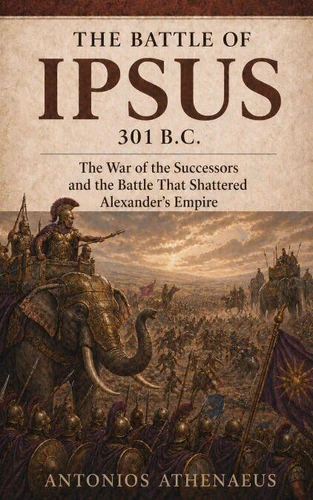
The Battle of Ipsus 301 B.C.: The War of the Successors and the Battle That Shattered Alexander’s Empire. Epic Battles of Ancient History, #17
Par :Formats :
Disponible dans votre compte client Decitre ou Furet du Nord dès validation de votre commande. Le format ePub est :
- Compatible avec une lecture sur My Vivlio (smartphone, tablette, ordinateur)
- Compatible avec une lecture sur liseuses Vivlio
- Pour les liseuses autres que Vivlio, vous devez utiliser le logiciel Adobe Digital Edition. Non compatible avec la lecture sur les liseuses Kindle, Remarkable et Sony
 , qui est-ce ?
Notre partenaire de plateforme de lecture numérique où vous retrouverez l'ensemble de vos ebooks gratuitement
Pour en savoir plus sur nos ebooks, consultez notre aide en ligne ici
C'est si simple ! Lisez votre ebook avec l'app Vivlio sur votre tablette, mobile ou ordinateur :

- FormatePub
- ISBN8235317055
- EAN9798235317055
- Date de parution04/05/2026
- Protection num.pas de protection
- Infos supplémentairesepub
- ÉditeurIoakim Ioakim
Résumé
At Ipsus, victory was not decided by strength alone-but by control of the battlefield. In 301 B. C., the successors of Alexander the Great faced one another in a decisive struggle that would determine the fate of his empire. No longer united by conquest, his generals turned their armies against each other in a war defined by ambition, rivalry, and the question of who would inherit power. At Ipsus, Antigonus Monophthalmus sought to impose unity by force.
Opposing him stood a coalition led by Seleucus and Lysimachus, prepared not just to resist-but to break him permanently. This book examines the Battle of Ipsus not simply as a large-scale clash of Hellenistic armies, but as a decisive operational contest shaped by maneuver, coordination, and timing. It analyzes the deployment of phalanxes, the decisive role of cavalry on the flanks, and above all the use of war elephants as an instrument of battlefield control rather than shock alone.
The battle was not won in a single moment of impact, but through the isolation of forces and the collapse of command cohesion. At the center stands Antigonus-experienced, ambitious, and determined to reunite Alexander's empire under his rule. Opposing him, Seleucus emerges as the architect of victory, using discipline, patience, and tactical awareness to exploit a critical opportunity. Demetrius' aggressive cavalry charge, initially successful, ultimately removed a decisive force from the battlefield, allowing the coalition to reshape the fight.
The engagement that followed was not symmetrical-it was controlled. Ipsus demonstrates a fundamental principle of warfare: battles are often decided not by destruction, but by separation. When forces lose the ability to support one another, even the strongest formation becomes vulnerable. Antigonus did not lose because his army was weaker-he lost because it was divided at the decisive moment. Drawing on ancient sources including Diodorus Siculus, Plutarch, and Appian, this study reconstructs the battle with clarity and analytical discipline.
The volume includes:. Strategic background of the Wars of the Successors. Detailed analysis of army composition and command structure. Step-by-step reconstruction of the battle phases. Tactical diagrams illustrating maneuver and engagement. Chronological timeline of the Ipsus campaign. Operational and strategic lessons applicable to modern warfareWritten for readers of military history, strategy, and classical warfare, this volume moves beyond narrative to examine how coordination, timing, and battlefield control determine victory.
Ipsus was not merely a battle. It was the moment Alexander's empire ceased to exist-and the Hellenistic world was born.
Opposing him stood a coalition led by Seleucus and Lysimachus, prepared not just to resist-but to break him permanently. This book examines the Battle of Ipsus not simply as a large-scale clash of Hellenistic armies, but as a decisive operational contest shaped by maneuver, coordination, and timing. It analyzes the deployment of phalanxes, the decisive role of cavalry on the flanks, and above all the use of war elephants as an instrument of battlefield control rather than shock alone.
The battle was not won in a single moment of impact, but through the isolation of forces and the collapse of command cohesion. At the center stands Antigonus-experienced, ambitious, and determined to reunite Alexander's empire under his rule. Opposing him, Seleucus emerges as the architect of victory, using discipline, patience, and tactical awareness to exploit a critical opportunity. Demetrius' aggressive cavalry charge, initially successful, ultimately removed a decisive force from the battlefield, allowing the coalition to reshape the fight.
The engagement that followed was not symmetrical-it was controlled. Ipsus demonstrates a fundamental principle of warfare: battles are often decided not by destruction, but by separation. When forces lose the ability to support one another, even the strongest formation becomes vulnerable. Antigonus did not lose because his army was weaker-he lost because it was divided at the decisive moment. Drawing on ancient sources including Diodorus Siculus, Plutarch, and Appian, this study reconstructs the battle with clarity and analytical discipline.
The volume includes:. Strategic background of the Wars of the Successors. Detailed analysis of army composition and command structure. Step-by-step reconstruction of the battle phases. Tactical diagrams illustrating maneuver and engagement. Chronological timeline of the Ipsus campaign. Operational and strategic lessons applicable to modern warfareWritten for readers of military history, strategy, and classical warfare, this volume moves beyond narrative to examine how coordination, timing, and battlefield control determine victory.
Ipsus was not merely a battle. It was the moment Alexander's empire ceased to exist-and the Hellenistic world was born.