SOLDES
Jusqu'à -70% sur une sélection d'articles*

Nouveauté
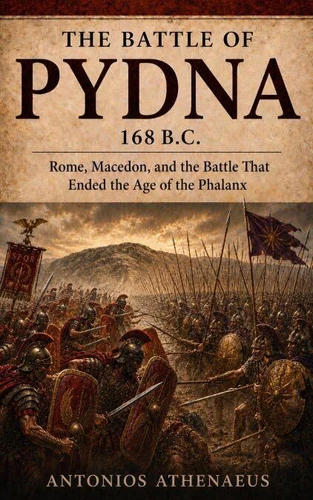
The Battle of Pydna 168 B.C.: Rome, Macedon, and the Battle That Ended the Age of the Phalanx. Epic Battles of Ancient History, #22
Par :Formats :
Disponible dans votre compte client Decitre ou Furet du Nord dès validation de votre commande. Le format ePub est :
- Compatible avec une lecture sur My Vivlio (smartphone, tablette, ordinateur)
- Compatible avec une lecture sur liseuses Vivlio
- Pour les liseuses autres que Vivlio, vous devez utiliser le logiciel Adobe Digital Edition. Non compatible avec la lecture sur les liseuses Kindle, Remarkable et Sony
 , qui est-ce ?
Notre partenaire de plateforme de lecture numérique où vous retrouverez l'ensemble de vos ebooks gratuitement
Pour en savoir plus sur nos ebooks, consultez notre aide en ligne ici
C'est si simple ! Lisez votre ebook avec l'app Vivlio sur votre tablette, mobile ou ordinateur :

- FormatePub
- ISBN8235046559
- EAN9798235046559
- Date de parution03/06/2026
- Protection num.pas de protection
- Infos supplémentairesepub
- ÉditeurIoakim Ioakim
Résumé
At Pydna, the age of the phalanx came to an end. In 168 B. C., Rome and Macedon met in a battle that would reshape the balance of power in the Mediterranean. For nearly two centuries, the Macedonian phalanx had dominated the battlefields of the Hellenistic world, carrying the legacy of Philip II and Alexander the Great. At Pydna, however, that legacy faced its greatest test against the disciplined flexibility of the Roman legion.
This book examines the Battle of Pydna not merely as the final engagement of the Third Macedonian War, but as one of history's most consequential military turning points. It explores the political tensions that led to war, the strategic calculations of King Perseus and Lucius Aemilius Paullus, and the operational decisions that brought two military systems into direct collision. At the center stands the confrontation between the Macedonian phalanx and the Roman legion.
The advance of the phalanx initially drove the Romans backward, demonstrating the terrifying power of the sarissa formation on favorable ground. Yet as the battle moved across uneven terrain, gaps opened within the Macedonian line. Roman commanders recognized the opportunity, exploiting the breaks in formation and transforming local disruptions into a decisive battlefield collapse. Pydna demonstrates a timeless military principle: tactical strength means little if cohesion cannot be maintained under changing battlefield conditions.
The battle revealed the limits of rigid formations and showcased the adaptability, initiative, and flexibility that made Rome the dominant military power of the ancient world. Drawing on ancient sources including Polybius, Livy, Plutarch, and Diodorus, this study reconstructs the battle with clarity and discipline. The volume includes:. Full political and strategic background of the Third Macedonian War.
Order of battle and force composition. Step-by-step battlefield reconstruction. Tactical diagrams and terrain analysis. Chronological timeline of the campaign. Examination of the phalanx-versus-legion debate. Operational and strategic lessons relevant to modern military thoughtWritten for readers of military history, strategy, and classical warfare, this volume moves beyond the familiar narrative of Roman expansion to examine how leadership, terrain, doctrine, and battlefield adaptability determine victory and defeat.
Pydna was not simply the defeat of a king. It was the battle that ended Macedonian power and marked the beginning of Rome's domination of the Greek world.
This book examines the Battle of Pydna not merely as the final engagement of the Third Macedonian War, but as one of history's most consequential military turning points. It explores the political tensions that led to war, the strategic calculations of King Perseus and Lucius Aemilius Paullus, and the operational decisions that brought two military systems into direct collision. At the center stands the confrontation between the Macedonian phalanx and the Roman legion.
The advance of the phalanx initially drove the Romans backward, demonstrating the terrifying power of the sarissa formation on favorable ground. Yet as the battle moved across uneven terrain, gaps opened within the Macedonian line. Roman commanders recognized the opportunity, exploiting the breaks in formation and transforming local disruptions into a decisive battlefield collapse. Pydna demonstrates a timeless military principle: tactical strength means little if cohesion cannot be maintained under changing battlefield conditions.
The battle revealed the limits of rigid formations and showcased the adaptability, initiative, and flexibility that made Rome the dominant military power of the ancient world. Drawing on ancient sources including Polybius, Livy, Plutarch, and Diodorus, this study reconstructs the battle with clarity and discipline. The volume includes:. Full political and strategic background of the Third Macedonian War.
Order of battle and force composition. Step-by-step battlefield reconstruction. Tactical diagrams and terrain analysis. Chronological timeline of the campaign. Examination of the phalanx-versus-legion debate. Operational and strategic lessons relevant to modern military thoughtWritten for readers of military history, strategy, and classical warfare, this volume moves beyond the familiar narrative of Roman expansion to examine how leadership, terrain, doctrine, and battlefield adaptability determine victory and defeat.
Pydna was not simply the defeat of a king. It was the battle that ended Macedonian power and marked the beginning of Rome's domination of the Greek world.