SOLDES
Jusqu'à -70% sur une sélection d'articles*

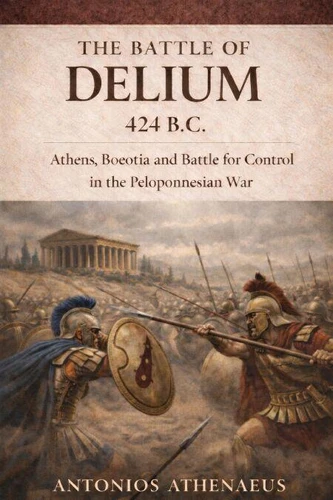
The Battle of Delium 424 B.C.: Athens, Boeotia and Battle for Control in the Peloponnesian War. Epic Battles of Ancient History, #15
Par :Formats :
Disponible dans votre compte client Decitre ou Furet du Nord dès validation de votre commande. Le format ePub est :
- Compatible avec une lecture sur My Vivlio (smartphone, tablette, ordinateur)
- Compatible avec une lecture sur liseuses Vivlio
- Pour les liseuses autres que Vivlio, vous devez utiliser le logiciel Adobe Digital Edition. Non compatible avec la lecture sur les liseuses Kindle, Remarkable et Sony
 , qui est-ce ?
Notre partenaire de plateforme de lecture numérique où vous retrouverez l'ensemble de vos ebooks gratuitement
Pour en savoir plus sur nos ebooks, consultez notre aide en ligne ici
C'est si simple ! Lisez votre ebook avec l'app Vivlio sur votre tablette, mobile ou ordinateur :

- FormatePub
- ISBN8235600492
- EAN9798235600492
- Date de parution27/04/2026
- Protection num.pas de protection
- Infos supplémentairesepub
- ÉditeurIoakim Ioakim
Résumé
At Delium, victory did not belong to the boldest army, but to the side that understood how discipline survives collapse. In 424 B. C., near the sanctuary of Apollo at Delium in Boeotia, an Athenian force confident in its initiative found itself trapped by its own assumptions. What began as a calculated occupation turned into a brutal and instructive defeat. The Battle of Delium was not decided by numbers or morale alone.
It was decided by command friction, breakdown of coordination, and the inability to control success once the battlefield turned against its architects. This book examines the Battle of Delium as a case study in failed operational design and contested command during the Peloponnesian War. Moving beyond the traditional narrative of hoplite clash, it analyzes how Athens misjudged the relationship between tactical action and strategic consequence, and how Boeotian cohesion, timing, and command resilience transformed a defensive response into a decisive counterstroke.
The study places Delium within its political and strategic context, exploring Athenian ambitions in Boeotia, the logic behind the fortification of the sanctuary, and the assumptions that shaped Athenian planning. It examines the Boeotian response not as improvisation, but as an adaptive system capable of exploiting enemy overextension. The Athenian army is analyzed as an effective but overstretched force, confident in initiative yet vulnerable to disruption once its plan unraveled.
Central to the analysis is the collapse of Athenian coordination during the withdrawal and the decisive employment of the Boeotian cavalry and reserve elements at the critical moment. The role of terrain, timing, and command communication is traced step by step, showing how tactical dislocation produced psychological shock and accelerated defeat. The battle demonstrates how even experienced forces fail when command control is lost under pressure.
The book is supported by battlefield diagrams, maps, and illustrated reconstructions that clarify formations, movement, and key decision points. It also situates Delium within a broader framework of military thought, drawing on theorists such as Thucydides, Clausewitz, and André Beaufre to explain why the battle remains relevant to discussions of command responsibility, operational limits, and the dangers of strategic overreach.
The Battle of Delium is written for readers of military history, ancient warfare, leadership, and strategy who seek analysis rather than legend. It forms part of the Epic Battles of Ancient History series, alongside The Battle of Cunaxa and The Battle of Leuctra, and precedes later examinations of Macedonian and classical warfare. Delium was not merely an Athenian defeat. It was a lesson in how initiative, once lost, can turn planning into liability-and how wars are often decided not at the moment of attack, but at the moment control slips away.
It was decided by command friction, breakdown of coordination, and the inability to control success once the battlefield turned against its architects. This book examines the Battle of Delium as a case study in failed operational design and contested command during the Peloponnesian War. Moving beyond the traditional narrative of hoplite clash, it analyzes how Athens misjudged the relationship between tactical action and strategic consequence, and how Boeotian cohesion, timing, and command resilience transformed a defensive response into a decisive counterstroke.
The study places Delium within its political and strategic context, exploring Athenian ambitions in Boeotia, the logic behind the fortification of the sanctuary, and the assumptions that shaped Athenian planning. It examines the Boeotian response not as improvisation, but as an adaptive system capable of exploiting enemy overextension. The Athenian army is analyzed as an effective but overstretched force, confident in initiative yet vulnerable to disruption once its plan unraveled.
Central to the analysis is the collapse of Athenian coordination during the withdrawal and the decisive employment of the Boeotian cavalry and reserve elements at the critical moment. The role of terrain, timing, and command communication is traced step by step, showing how tactical dislocation produced psychological shock and accelerated defeat. The battle demonstrates how even experienced forces fail when command control is lost under pressure.
The book is supported by battlefield diagrams, maps, and illustrated reconstructions that clarify formations, movement, and key decision points. It also situates Delium within a broader framework of military thought, drawing on theorists such as Thucydides, Clausewitz, and André Beaufre to explain why the battle remains relevant to discussions of command responsibility, operational limits, and the dangers of strategic overreach.
The Battle of Delium is written for readers of military history, ancient warfare, leadership, and strategy who seek analysis rather than legend. It forms part of the Epic Battles of Ancient History series, alongside The Battle of Cunaxa and The Battle of Leuctra, and precedes later examinations of Macedonian and classical warfare. Delium was not merely an Athenian defeat. It was a lesson in how initiative, once lost, can turn planning into liability-and how wars are often decided not at the moment of attack, but at the moment control slips away.