SOLDES
Jusqu'à -70% sur une sélection d'articles*

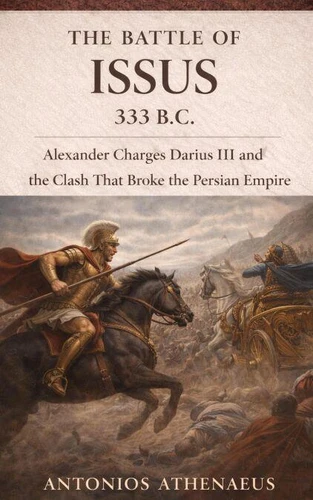
The Battle of Issus 333 B.C.: Alexander Charges Darius III and the Clash That Broke the Persian Empire. Epic Battles of Ancient History, #10
Par :Formats :
Disponible dans votre compte client Decitre ou Furet du Nord dès validation de votre commande. Le format ePub est :
- Compatible avec une lecture sur My Vivlio (smartphone, tablette, ordinateur)
- Compatible avec une lecture sur liseuses Vivlio
- Pour les liseuses autres que Vivlio, vous devez utiliser le logiciel Adobe Digital Edition. Non compatible avec la lecture sur les liseuses Kindle, Remarkable et Sony
 , qui est-ce ?
Notre partenaire de plateforme de lecture numérique où vous retrouverez l'ensemble de vos ebooks gratuitement
Pour en savoir plus sur nos ebooks, consultez notre aide en ligne ici
C'est si simple ! Lisez votre ebook avec l'app Vivlio sur votre tablette, mobile ou ordinateur :

- FormatePub
- ISBN8233319334
- EAN9798233319334
- Date de parution01/04/2026
- Protection num.pas de protection
- Infos supplémentairesepub
- ÉditeurLinda Balsamo
Résumé
At Issus, terrain did not limit the battle. It redefined it. In 333 B. C., Alexander of Macedon confronted Darius III in a narrow coastal corridor where the vast numerical superiority of the Persian army could not be fully deployed. What might have been a battle of scale became instead a contest of structure, cohesion, and decisive execution. Issus was not won by numbers. It was decided by control.
This book presents the Battle of Issus as an operational study in constrained battlespace, command effectiveness, and the exploitation of opportunity under pressure. Rather than retelling a familiar narrative of pursuit and collapse, it examines how Alexander imposed order on a compressed battlefield and how the Persian command system failed to adapt to the conditions it had created. Drawing on ancient sources including Arrian, Diodorus, Curtius Rufus, and Plutarch, the study reconstructs the engagement with analytical precision.
The advance of the Macedonian phalanx across the Pinarus, the intense struggle against the Greek mercenaries, and the decisive right-wing attack led by Alexander are examined as interconnected elements of a unified operational design. The Persian deployment-anchored on the river line with strong cavalry on the flanks and elite infantry at the center-is assessed through a tactical and structural lens, revealing how constrained terrain neutralized its advantages while amplifying its vulnerabilities.
Particular attention is given to moments of critical tension: the pressure on Parmenion's wing, the strain on the Macedonian center, and the decisive impact of Alexander's maneuver toward the Persian rear. Issus was not a foregone conclusion. It was decided at the point where cohesion held-and where it broke. The volume includes detailed battlefield diagrams, phase-by-phase reconstruction, and focused analysis of command, terrain, and combat dynamics.
It is written for readers seeking clarity, structure, and serious military interpretation beyond conventional narrative. Issus was not merely a victory. It was the moment when the Persian army lost its ability to fight as a system-and the war began to turn irreversibly.
This book presents the Battle of Issus as an operational study in constrained battlespace, command effectiveness, and the exploitation of opportunity under pressure. Rather than retelling a familiar narrative of pursuit and collapse, it examines how Alexander imposed order on a compressed battlefield and how the Persian command system failed to adapt to the conditions it had created. Drawing on ancient sources including Arrian, Diodorus, Curtius Rufus, and Plutarch, the study reconstructs the engagement with analytical precision.
The advance of the Macedonian phalanx across the Pinarus, the intense struggle against the Greek mercenaries, and the decisive right-wing attack led by Alexander are examined as interconnected elements of a unified operational design. The Persian deployment-anchored on the river line with strong cavalry on the flanks and elite infantry at the center-is assessed through a tactical and structural lens, revealing how constrained terrain neutralized its advantages while amplifying its vulnerabilities.
Particular attention is given to moments of critical tension: the pressure on Parmenion's wing, the strain on the Macedonian center, and the decisive impact of Alexander's maneuver toward the Persian rear. Issus was not a foregone conclusion. It was decided at the point where cohesion held-and where it broke. The volume includes detailed battlefield diagrams, phase-by-phase reconstruction, and focused analysis of command, terrain, and combat dynamics.
It is written for readers seeking clarity, structure, and serious military interpretation beyond conventional narrative. Issus was not merely a victory. It was the moment when the Persian army lost its ability to fight as a system-and the war began to turn irreversibly.