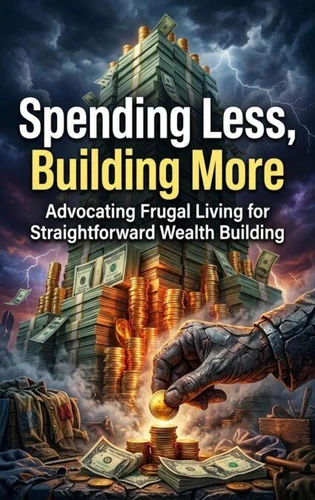
Spending Less, Building More. Advocating Frugal Living for Straightforward Wealth Building
Par :Formats :
Disponible dans votre compte client Decitre ou Furet du Nord dès validation de votre commande. Le format ePub est :
- Compatible avec une lecture sur My Vivlio (smartphone, tablette, ordinateur)
- Compatible avec une lecture sur liseuses Vivlio
- Pour les liseuses autres que Vivlio, vous devez utiliser le logiciel Adobe Digital Edition. Non compatible avec la lecture sur les liseuses Kindle, Remarkable et Sony
 , qui est-ce ?
Notre partenaire de plateforme de lecture numérique où vous retrouverez l'ensemble de vos ebooks gratuitement
Pour en savoir plus sur nos ebooks, consultez notre aide en ligne ici
C'est si simple ! Lisez votre ebook avec l'app Vivlio sur votre tablette, mobile ou ordinateur :

- Nombre de pages185
- FormatePub
- ISBN978-3-565-39670-2
- EAN9783565396702
- Date de parution09/04/2026
- Protection num.pas de protection
- Taille2 Mo
- Infos supplémentairesepub
- ÉditeurEmphaloz Publishing House
Résumé
Frugality is one of the most empirically validated wealth-building strategies available - yet it remains systematically undervalued in a financial culture that equates prosperity with consumption. Longitudinal studies conducted between 2020 and 2025 reveal that frugal households accumulate assets up to 7.6 times faster than their consumerist counterparts, driven not by superior income but by the disciplined compounding of sustained savings over time.
The wealth gap, in many cases, is not an income gap - it is a spending discipline gap. This book examines frugality not as austerity or deprivation, but as a coherent strategic framework for aligning daily financial behavior with long-term wealth creation. It explores how the deliberate avoidance of lifestyle inflation, the prioritization of essential over discretionary spending, and the systematic redirection of saved capital into productive assets form a structural pathway to financial independence accessible to virtually any income level.
A 20% savings rate on a moderate income, when consistently deployed and compounded, can rival or exceed the wealth trajectory of a high earner with undisciplined spending habits. Beyond the mechanics of budgeting and expense reduction, this book addresses the deeper behavioral and psychological dimensions of frugal living - why high earners often remain financially fragile, how lifestyle creep silently erodes decades of earning potential, and why the habits of the quietly wealthy consistently reflect the same foundational principles of intentional restraint.
Wealth, in its most durable form, is never the product of what one earns - it is the product of what one chooses not to spend.
The wealth gap, in many cases, is not an income gap - it is a spending discipline gap. This book examines frugality not as austerity or deprivation, but as a coherent strategic framework for aligning daily financial behavior with long-term wealth creation. It explores how the deliberate avoidance of lifestyle inflation, the prioritization of essential over discretionary spending, and the systematic redirection of saved capital into productive assets form a structural pathway to financial independence accessible to virtually any income level.
A 20% savings rate on a moderate income, when consistently deployed and compounded, can rival or exceed the wealth trajectory of a high earner with undisciplined spending habits. Beyond the mechanics of budgeting and expense reduction, this book addresses the deeper behavioral and psychological dimensions of frugal living - why high earners often remain financially fragile, how lifestyle creep silently erodes decades of earning potential, and why the habits of the quietly wealthy consistently reflect the same foundational principles of intentional restraint.
Wealth, in its most durable form, is never the product of what one earns - it is the product of what one chooses not to spend.