Nouveauté
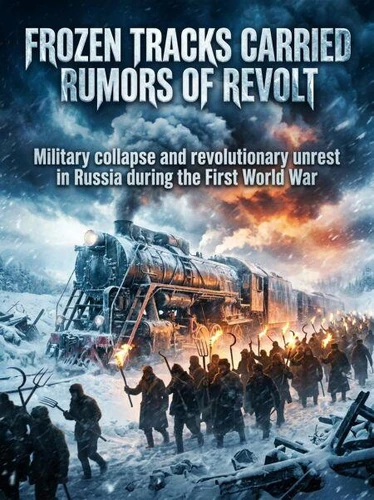
Frozen Tracks Carried Rumors of Revolt. Military collapse and revolutionary unrest in Russia during the First World War
Par :Formats :
Disponible dans votre compte client Decitre ou Furet du Nord dès validation de votre commande. Le format ePub est :
- Compatible avec une lecture sur My Vivlio (smartphone, tablette, ordinateur)
- Compatible avec une lecture sur liseuses Vivlio
- Pour les liseuses autres que Vivlio, vous devez utiliser le logiciel Adobe Digital Edition. Non compatible avec la lecture sur les liseuses Kindle, Remarkable et Sony
 , qui est-ce ?
Notre partenaire de plateforme de lecture numérique où vous retrouverez l'ensemble de vos ebooks gratuitement
Pour en savoir plus sur nos ebooks, consultez notre aide en ligne ici
C'est si simple ! Lisez votre ebook avec l'app Vivlio sur votre tablette, mobile ou ordinateur :

- Nombre de pages173
- FormatePub
- ISBN978-3-565-48572-7
- EAN9783565485727
- Date de parution08/06/2026
- Protection num.pas de protection
- Taille1 Mo
- Infos supplémentairesepub
- ÉditeurEmphaloz Publishing House
Résumé
Russia entered the First World War with imperial confidence and left it consumed by mutiny, shortages, and political despair. Behind the front lines, exhausted rail systems failed to deliver food, ammunition, and medical supplies to millions of soldiers increasingly abandoned by the state they served.
This account examines how military breakdown accelerated the destruction of the Romanov Empire.
Using operational records, soldiers' letters, and government archives, the book reconstructs the logistical paralysis that crippled Russia's wartime campaign. Command failures, industrial weakness, and severe winter conditions transformed the front into an environment where morale collapsed faster than official reports admitted. The barracks themselves became political spaces. Radical ideologies circulated through officers' frustrations, peasant grievances, and urban labor unrest carried directly into military life.
As battlefield defeats multiplied, confidence in Tsar Nicholas II deteriorated among civilians and soldiers alike. Secret diplomatic communication between the Romanovs and European monarchies revealed growing fears that the empire could no longer stabilize itself without external support. Seen through war, the fall of imperial Russia emerges not as sudden revolution, but as a state exhausted beyond recovery.
Using operational records, soldiers' letters, and government archives, the book reconstructs the logistical paralysis that crippled Russia's wartime campaign. Command failures, industrial weakness, and severe winter conditions transformed the front into an environment where morale collapsed faster than official reports admitted. The barracks themselves became political spaces. Radical ideologies circulated through officers' frustrations, peasant grievances, and urban labor unrest carried directly into military life.
As battlefield defeats multiplied, confidence in Tsar Nicholas II deteriorated among civilians and soldiers alike. Secret diplomatic communication between the Romanovs and European monarchies revealed growing fears that the empire could no longer stabilize itself without external support. Seen through war, the fall of imperial Russia emerges not as sudden revolution, but as a state exhausted beyond recovery.