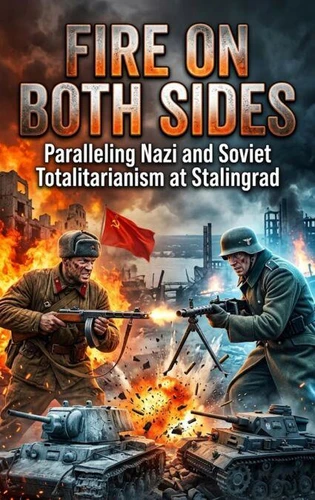
Fire on Both Sides. Paralleling Nazi and Soviet Totalitarianism at Stalingrad
Par :Formats :
Disponible dans votre compte client Decitre ou Furet du Nord dès validation de votre commande. Le format ePub est :
- Compatible avec une lecture sur My Vivlio (smartphone, tablette, ordinateur)
- Compatible avec une lecture sur liseuses Vivlio
- Pour les liseuses autres que Vivlio, vous devez utiliser le logiciel Adobe Digital Edition. Non compatible avec la lecture sur les liseuses Kindle, Remarkable et Sony
 , qui est-ce ?
Notre partenaire de plateforme de lecture numérique où vous retrouverez l'ensemble de vos ebooks gratuitement
Pour en savoir plus sur nos ebooks, consultez notre aide en ligne ici
C'est si simple ! Lisez votre ebook avec l'app Vivlio sur votre tablette, mobile ou ordinateur :

- Nombre de pages170
- FormatePub
- ISBN978-3-565-41011-8
- EAN9783565410118
- Date de parution14/04/2026
- Protection num.pas de protection
- Taille2 Mo
- Infos supplémentairesepub
- ÉditeurEmphaloz Publishing House
Résumé
Stalingrad was not merely a battle - it was a collision of two totalitarian systems that shared more than either side would ever admit. Hitler ordered the annihilation of the city's population, declaring its civilians "thoroughly communistic" and deserving of death or deportation. Stalin, on the other side of the same rubble, refused to evacuate those same civilians, calculating that soldiers fight harder when ordinary lives are present to defend.
Both men used human beings as instruments of ideological will, and both condemned hundreds of thousands to die in the service of a name - the name of a city, the name of a dictator, the name of a cause. Scholars have long noted the structural mirror between Hitler and Stalin: Hitler's subordinates feared failure; Stalin's feared survival. Hitler became increasingly alienated from his generals as the battle turned, refusing tactical retreats on ideological grounds; Stalin, driven by paranoia of equal ferocity, had already decimated his officer corps in the purges of the 1930s, and yet slowly - and unlike Hitler - began learning to trust military judgment as the war progressed.
The battle thus became a study not only in military strategy but in the pathology of absolute power, where the same mistakes were made on both sides of the Volga for entirely different ideological reasons. For the soldiers buried in its ruins and the civilians who endured what followed, Stalingrad was a place where two systems competed not to liberate but to dominate. German forces drove tens of thousands of Stalingraders westward on foot into camps with no provisions, while Soviet authorities suppressed "evacuation moods" as defeatism, trapping their own people in a burning city.
Between the Nazi Einsatzgruppen orders and the NKVD's lists of enemies of the people, the ordinary human being at Stalingrad had no ideology - only the desperate arithmetic of staying alive.
Both men used human beings as instruments of ideological will, and both condemned hundreds of thousands to die in the service of a name - the name of a city, the name of a dictator, the name of a cause. Scholars have long noted the structural mirror between Hitler and Stalin: Hitler's subordinates feared failure; Stalin's feared survival. Hitler became increasingly alienated from his generals as the battle turned, refusing tactical retreats on ideological grounds; Stalin, driven by paranoia of equal ferocity, had already decimated his officer corps in the purges of the 1930s, and yet slowly - and unlike Hitler - began learning to trust military judgment as the war progressed.
The battle thus became a study not only in military strategy but in the pathology of absolute power, where the same mistakes were made on both sides of the Volga for entirely different ideological reasons. For the soldiers buried in its ruins and the civilians who endured what followed, Stalingrad was a place where two systems competed not to liberate but to dominate. German forces drove tens of thousands of Stalingraders westward on foot into camps with no provisions, while Soviet authorities suppressed "evacuation moods" as defeatism, trapping their own people in a burning city.
Between the Nazi Einsatzgruppen orders and the NKVD's lists of enemies of the people, the ordinary human being at Stalingrad had no ideology - only the desperate arithmetic of staying alive.
A propos de Hollis Parr



24,99 €



9,99 €