A union organizer turned writer who fought for rights firsthand, combining self-help advocacy tools, business ethics on fair labor, and histories of worker uprisings across centuries.
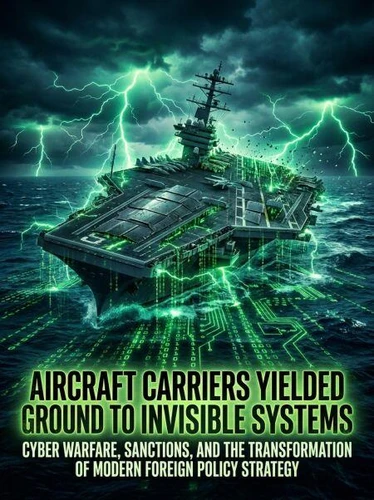
Aircraft Carriers Yielded Ground to Invisible Systems. Cyber warfare, sanctions, and the transformation of modern foreign policy strategy
Par :Formats :
Disponible dans votre compte client Decitre ou Furet du Nord dès validation de votre commande. Le format ePub est :
- Compatible avec une lecture sur My Vivlio (smartphone, tablette, ordinateur)
- Compatible avec une lecture sur liseuses Vivlio
- Pour les liseuses autres que Vivlio, vous devez utiliser le logiciel Adobe Digital Edition. Non compatible avec la lecture sur les liseuses Kindle, Remarkable et Sony
 , qui est-ce ?
Notre partenaire de plateforme de lecture numérique où vous retrouverez l'ensemble de vos ebooks gratuitement
Pour en savoir plus sur nos ebooks, consultez notre aide en ligne ici
C'est si simple ! Lisez votre ebook avec l'app Vivlio sur votre tablette, mobile ou ordinateur :

- Nombre de pages223
- FormatePub
- ISBN978-3-565-47785-2
- EAN9783565477852
- Date de parution05/06/2026
- Protection num.pas de protection
- Taille1 Mo
- Infos supplémentairesepub
- ÉditeurEmphaloz Publishing House
Résumé
Military dominance no longer depends solely on fleets, invasions, or territorial occupation. In the twenty-first century, states increasingly project power through digital infrastructure, financial pressure, intelligence networks, and economic dependency. Warfare expanded beyond battlefields into banking systems, communication platforms, and global supply chains.
This book examines the evolution of foreign policy from conventional hard power toward forms of strategic influence often described as smart power.
Governments developed cyber capabilities capable of disrupting infrastructure without direct military confrontation, while sanctions regimes emerged as tools for isolating rivals economically and politically. Diplomatic pressure increasingly operated through technology access, currency systems, and control over global information networks. The narrative also explores how military alliances adapted to this transition.
Overseas bases, intelligence-sharing agreements, and regional security partnerships remained essential, yet their role shifted toward maintaining technological and financial leverage rather than territorial conquest alone. Strategic competition now unfolds simultaneously across cyberspace, trade systems, and public perception. Modern hegemony therefore appears less dependent on occupying land than on controlling the systems through which economies, communications, and states remain interconnected.
Governments developed cyber capabilities capable of disrupting infrastructure without direct military confrontation, while sanctions regimes emerged as tools for isolating rivals economically and politically. Diplomatic pressure increasingly operated through technology access, currency systems, and control over global information networks. The narrative also explores how military alliances adapted to this transition.
Overseas bases, intelligence-sharing agreements, and regional security partnerships remained essential, yet their role shifted toward maintaining technological and financial leverage rather than territorial conquest alone. Strategic competition now unfolds simultaneously across cyberspace, trade systems, and public perception. Modern hegemony therefore appears less dependent on occupying land than on controlling the systems through which economies, communications, and states remain interconnected.
A propos de Hollis Parr






24,99 €





9,99 €