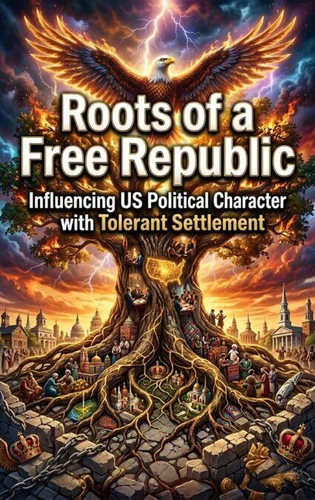
Roots of a Free Republic. Influencing US Political Character with Tolerant Settlement
Par :Formats :
Disponible dans votre compte client Decitre ou Furet du Nord dès validation de votre commande. Le format ePub est :
- Compatible avec une lecture sur My Vivlio (smartphone, tablette, ordinateur)
- Compatible avec une lecture sur liseuses Vivlio
- Pour les liseuses autres que Vivlio, vous devez utiliser le logiciel Adobe Digital Edition. Non compatible avec la lecture sur les liseuses Kindle, Remarkable et Sony
 , qui est-ce ?
Notre partenaire de plateforme de lecture numérique où vous retrouverez l'ensemble de vos ebooks gratuitement
Pour en savoir plus sur nos ebooks, consultez notre aide en ligne ici
C'est si simple ! Lisez votre ebook avec l'app Vivlio sur votre tablette, mobile ou ordinateur :

- Nombre de pages137
- FormatePub
- ISBN978-3-565-40933-4
- EAN9783565409334
- Date de parution14/04/2026
- Protection num.pas de protection
- Taille2 Mo
- Infos supplémentairesepub
- ÉditeurEmphaloz Publishing House
Résumé
The American political character - its instinct for pluralism, its suspicion of established authority, its insistence on the right of conscience - was not invented by the Founders in Philadelphia in 1787. It was grown, slowly and unevenly, across the seventeenth century in the soil of colonies that had no common theology, no common language, and no single vision of what a good society should look like.
The Framers did not create American pluralism. They codified what the colonial experience had already proved possible. Roots of a Free Republic traces how the specific conditions of tolerant settlement shaped the long-term political DNA of the United States. It moves through the founding laboratories of pluralism: Roger Williams's Rhode Island, established in 1636 as a deliberate experiment in tying civil order to the freedom of conscience rather than the authority of a church; William Penn's Pennsylvania, where the 1701 Charter of Privileges created a framework for religious coexistence that attracted Quakers, German Reformed pietists, French Huguenots, Jews, and Catholics to a single colony - and demonstrated, as Jefferson would later note, that "all sects might safely be put on a footing of equal and entire freedom"; and the heterogeneous Middle Colonies, where no single denomination could dominate and where the practice of tolerance became, by necessity, the foundation of civic life.
The Framers did not create American pluralism. They codified what the colonial experience had already proved possible. Roots of a Free Republic traces how the specific conditions of tolerant settlement shaped the long-term political DNA of the United States. It moves through the founding laboratories of pluralism: Roger Williams's Rhode Island, established in 1636 as a deliberate experiment in tying civil order to the freedom of conscience rather than the authority of a church; William Penn's Pennsylvania, where the 1701 Charter of Privileges created a framework for religious coexistence that attracted Quakers, German Reformed pietists, French Huguenots, Jews, and Catholics to a single colony - and demonstrated, as Jefferson would later note, that "all sects might safely be put on a footing of equal and entire freedom"; and the heterogeneous Middle Colonies, where no single denomination could dominate and where the practice of tolerance became, by necessity, the foundation of civic life.