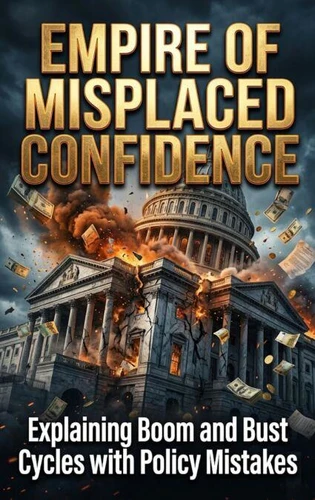
Empire of Misplaced Confidence. Explaining Boom and Bust Cycles with Policy Mistakes
Par :Formats :
Disponible dans votre compte client Decitre ou Furet du Nord dès validation de votre commande. Le format ePub est :
- Compatible avec une lecture sur My Vivlio (smartphone, tablette, ordinateur)
- Compatible avec une lecture sur liseuses Vivlio
- Pour les liseuses autres que Vivlio, vous devez utiliser le logiciel Adobe Digital Edition. Non compatible avec la lecture sur les liseuses Kindle, Remarkable et Sony
 , qui est-ce ?
Notre partenaire de plateforme de lecture numérique où vous retrouverez l'ensemble de vos ebooks gratuitement
Pour en savoir plus sur nos ebooks, consultez notre aide en ligne ici
C'est si simple ! Lisez votre ebook avec l'app Vivlio sur votre tablette, mobile ou ordinateur :

- Nombre de pages210
- FormatePub
- ISBN978-3-565-41085-9
- EAN9783565410859
- Date de parution14/04/2026
- Protection num.pas de protection
- Taille2 Mo
- Infos supplémentairesepub
- ÉditeurEmphaloz Publishing House
Résumé
Every great financial collapse in modern history carries, buried somewhere in its wreckage, the same evidence: a policy decision made too late, held too long, or calibrated for a world that no longer existed. The boom and bust cycle is not a natural disaster - it is an engineered one. Its anatomy is consistent across centuries: central banks lower interest rates, credit becomes cheap and plentiful, leverage multiplies, asset prices detach from underlying value, optimism becomes structural, and then - when the rate rises, or confidence falters, or a single institution stumbles - the same feedback loops that amplified the boom accelerate the collapse with equal and opposite force.
The 2007-2009 Global Financial Crisis offers the clearest modern anatomy of policy failure at scale.
John Taylor of Stanford University demonstrated a strong statistical relationship between the Federal Reserve's deviation from its own historical interest rate precedents in the early 2000s and the subsequent housing boom - arguing that the Fed kept rates too low for too long, creating the credit conditions in which misinvestment became not merely possible but structurally inevitable. The regulatory framework compounded the error: rules allowed and in some cases actively encouraged activities that fuelled the housing bubble, while systemic risk was obscured by banks' interactions with less-regulated nonbank institutions whose fragility remained invisible to supervisors until it was catastrophic.
When the crisis arrived, a further layer of policy failure prolonged it - misdiagnosing the problem as a liquidity crisis rather than a risk crisis, and responding with instruments calibrated for the wrong disease.
John Taylor of Stanford University demonstrated a strong statistical relationship between the Federal Reserve's deviation from its own historical interest rate precedents in the early 2000s and the subsequent housing boom - arguing that the Fed kept rates too low for too long, creating the credit conditions in which misinvestment became not merely possible but structurally inevitable. The regulatory framework compounded the error: rules allowed and in some cases actively encouraged activities that fuelled the housing bubble, while systemic risk was obscured by banks' interactions with less-regulated nonbank institutions whose fragility remained invisible to supervisors until it was catastrophic.
When the crisis arrived, a further layer of policy failure prolonged it - misdiagnosing the problem as a liquidity crisis rather than a risk crisis, and responding with instruments calibrated for the wrong disease.