Nouveauté
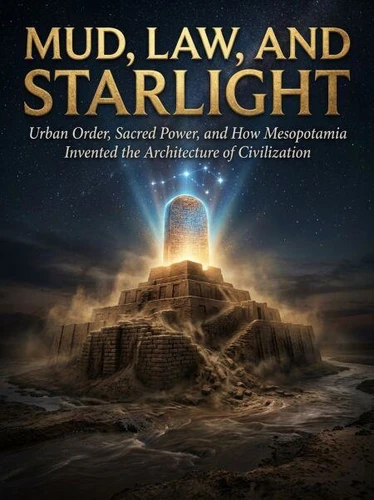
Mud, Law, and Starlight. Urban Order, Sacred Power, and How Mesopotamia Invented the Architecture of Civilization
Par :Formats :
Disponible dans votre compte client Decitre ou Furet du Nord dès validation de votre commande. Le format ePub est :
- Compatible avec une lecture sur My Vivlio (smartphone, tablette, ordinateur)
- Compatible avec une lecture sur liseuses Vivlio
- Pour les liseuses autres que Vivlio, vous devez utiliser le logiciel Adobe Digital Edition. Non compatible avec la lecture sur les liseuses Kindle, Remarkable et Sony
 , qui est-ce ?
Notre partenaire de plateforme de lecture numérique où vous retrouverez l'ensemble de vos ebooks gratuitement
Pour en savoir plus sur nos ebooks, consultez notre aide en ligne ici
C'est si simple ! Lisez votre ebook avec l'app Vivlio sur votre tablette, mobile ou ordinateur :

- Nombre de pages527
- FormatePub
- ISBN978-3-565-63489-7
- EAN9783565634897
- Date de parution11/08/2026
- Protection num.pas de protection
- Taille1 Mo
- Infos supplémentairesepub
- ÉditeurEmphaloz Publishing House
Résumé
Civilization did not begin with an idea. It began with water - with the problem of two rivers that could flood without warning, dry without mercy, and sustain millions if only they could be made to obey. Between the Tigris and the Euphrates, in the flat alluvial plains of ancient Mesopotamia, humanity first attempted to organize itself on a scale that required something entirely new: institutions that could outlast any single ruler, any single season, any single memory.
The city was the first of those institutions.
Babylon did not simply grow. It was administered. Streets were planned, temples were positioned, grain was counted, and labor was assigned through systems of notation that gave the world its first sustained encounter with written law. The Code of Hammurabi was not merely a legal document. It was a political architecture - a ruler's claim that justice was not his personal gift but a cosmic obligation, visible on stone, accountable to gods and subjects alike.
In this translation of divine authority into durable text lay one of the oldest mechanisms of state legitimacy ever constructed. Beneath the theological scaffolding ran the practical intelligence of an agrarian civilization under permanent hydraulic pressure.
Babylon did not simply grow. It was administered. Streets were planned, temples were positioned, grain was counted, and labor was assigned through systems of notation that gave the world its first sustained encounter with written law. The Code of Hammurabi was not merely a legal document. It was a political architecture - a ruler's claim that justice was not his personal gift but a cosmic obligation, visible on stone, accountable to gods and subjects alike.
In this translation of divine authority into durable text lay one of the oldest mechanisms of state legitimacy ever constructed. Beneath the theological scaffolding ran the practical intelligence of an agrarian civilization under permanent hydraulic pressure.