Nouveauté
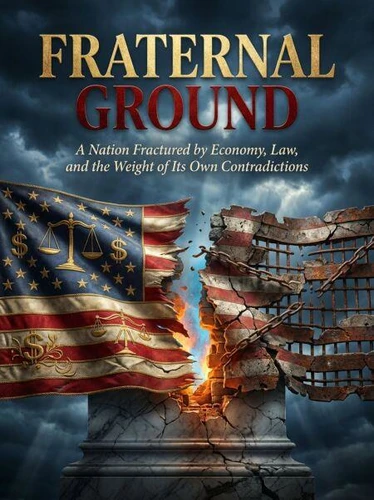
Fraternal Ground. A Nation Fractured by Economy, Law, and the Weight of Its Own Contradictions
Par :Formats :
Disponible dans votre compte client Decitre ou Furet du Nord dès validation de votre commande. Le format ePub est :
- Compatible avec une lecture sur My Vivlio (smartphone, tablette, ordinateur)
- Compatible avec une lecture sur liseuses Vivlio
- Pour les liseuses autres que Vivlio, vous devez utiliser le logiciel Adobe Digital Edition. Non compatible avec la lecture sur les liseuses Kindle, Remarkable et Sony
 , qui est-ce ?
Notre partenaire de plateforme de lecture numérique où vous retrouverez l'ensemble de vos ebooks gratuitement
Pour en savoir plus sur nos ebooks, consultez notre aide en ligne ici
C'est si simple ! Lisez votre ebook avec l'app Vivlio sur votre tablette, mobile ou ordinateur :

- Nombre de pages509
- FormatePub
- ISBN978-3-565-63465-1
- EAN9783565634651
- Date de parution11/08/2026
- Protection num.pas de protection
- Taille1 Mo
- Infos supplémentairesepub
- ÉditeurEmphaloz Publishing House
Résumé
Every civil war contains within it a prior failure - not of armies, but of imagination. The American Civil War did not erupt because compromise was impossible. It erupted because the contradictions embedded in the republic's founding had been managed rather than resolved, deferred rather than confronted, until deferral itself became untenable. By 1860, the United States was not one nation with a conflict.
It was two economic civilizations occupying the same constitutional framework, each convinced the other threatened its survival. The structural divide had hardened over generations. Northern industrialization created a wage-labor society with urban density, mechanized production, and economic ambitions oriented toward protective tariffs and continental markets. The Southern plantation economy operated on an entirely different logic - one in which land, labor, and human bondage were not separable components but a single integrated system.
These were not merely regional preferences. They were incompatible visions of what American society was meant to become, and every political negotiation over new territories forced that incompatibility into visibility. Constitutional law became the arena where irreconcilable interests staged their final confrontations. From the Missouri Compromise to the Kansas-Nebraska Act and the Dred Scott decision, each legal mechanism designed to contain the conflict instead clarified its depth.
It was two economic civilizations occupying the same constitutional framework, each convinced the other threatened its survival. The structural divide had hardened over generations. Northern industrialization created a wage-labor society with urban density, mechanized production, and economic ambitions oriented toward protective tariffs and continental markets. The Southern plantation economy operated on an entirely different logic - one in which land, labor, and human bondage were not separable components but a single integrated system.
These were not merely regional preferences. They were incompatible visions of what American society was meant to become, and every political negotiation over new territories forced that incompatibility into visibility. Constitutional law became the arena where irreconcilable interests staged their final confrontations. From the Missouri Compromise to the Kansas-Nebraska Act and the Dred Scott decision, each legal mechanism designed to contain the conflict instead clarified its depth.