He explores historical insight, modern business thinking, and personal development in a clean and authoritative style.
Nouveauté
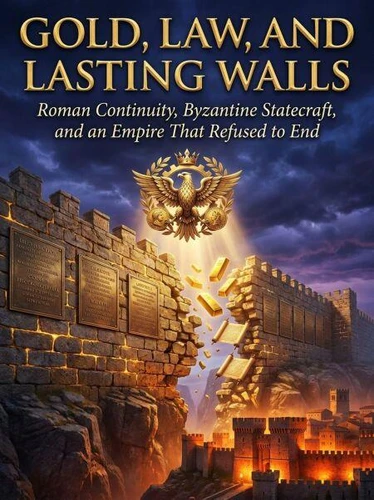
Gold, Law, and Lasting Walls. Roman Continuity, Byzantine Statecraft, and an Empire That Refused to End
Par :Formats :
Disponible dans votre compte client Decitre ou Furet du Nord dès validation de votre commande. Le format ePub est :
- Compatible avec une lecture sur My Vivlio (smartphone, tablette, ordinateur)
- Compatible avec une lecture sur liseuses Vivlio
- Pour les liseuses autres que Vivlio, vous devez utiliser le logiciel Adobe Digital Edition. Non compatible avec la lecture sur les liseuses Kindle, Remarkable et Sony
 , qui est-ce ?
Notre partenaire de plateforme de lecture numérique où vous retrouverez l'ensemble de vos ebooks gratuitement
Pour en savoir plus sur nos ebooks, consultez notre aide en ligne ici
C'est si simple ! Lisez votre ebook avec l'app Vivlio sur votre tablette, mobile ou ordinateur :

- Nombre de pages575
- FormatePub
- ISBN978-3-565-63475-0
- EAN9783565634750
- Date de parution11/08/2026
- Protection num.pas de protection
- Taille1 Mo
- Infos supplémentairesepub
- ÉditeurEmphaloz Publishing House
Résumé
Empires are not preserved by armies alone. They endure through the systems they embed in law, currency, and the calculated management of threat - structures so durable that successor civilizations inherit them without always knowing their origin. Byzantium is the most misunderstood empire in Western historical memory: dismissed as Rome's decadent remnant, it was in truth one of history's most sophisticated administrative organisms, one that survived for over a millennium precisely because it transformed continuity into a political discipline.
When Justinian commissioned the Corpus Juris Civilis in the sixth century, he did not merely organize existing Roman law.
He recast legal inheritance as an act of sovereignty - creating a codified system so architecturally coherent that it became the structural foundation for the civil law traditions of France, Germany, Italy, and much of the modern world. Law was not administration in Byzantium. It was ideology made permanent. The empire's survival against nomadic pressure - Avars, Bulgars, Pechenegs, and the waves of steppe confederacies that destabilized every neighbor - was not the product of overwhelming military superiority.
Byzantine defense operated through a layered architecture of intelligence, diplomatic subsidy, strategic fragmentation of enemy coalitions, and the near-mythological walls of Constantinople, which held for over eight hundred years.
He recast legal inheritance as an act of sovereignty - creating a codified system so architecturally coherent that it became the structural foundation for the civil law traditions of France, Germany, Italy, and much of the modern world. Law was not administration in Byzantium. It was ideology made permanent. The empire's survival against nomadic pressure - Avars, Bulgars, Pechenegs, and the waves of steppe confederacies that destabilized every neighbor - was not the product of overwhelming military superiority.
Byzantine defense operated through a layered architecture of intelligence, diplomatic subsidy, strategic fragmentation of enemy coalitions, and the near-mythological walls of Constantinople, which held for over eight hundred years.
A propos de Julian Crest





9,99 €