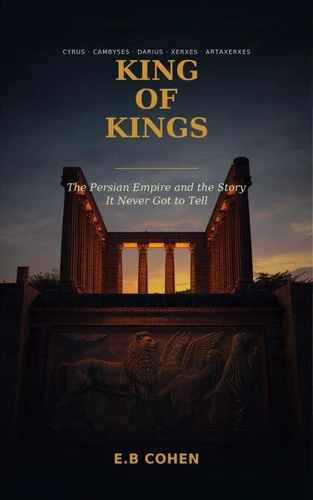
For two centuries the Achaemenid Persian Empire stretched from the Aegean to the Indus - the largest state the world had yet seen, ruled from Persepolis by a King of Kings who governed more of humanity than anyone before him. And then it went quiet. Not because the Persians had nothing to say, but because they wrote their empire in Aramaic on leather and papyrus, which rots, while their enemies wrote in Greek on scrolls that were copied for two thousand years.
Persia lost the argument about itself by default. This is the empire told from the inside, using what the Persians actually left behind: the vast inscription Darius carved a hundred metres up a cliff at Behistun; thirty thousand clay tablets from a Persepolis rubbish wall, baked hard - and so preserved - by the fire Alexander set; sealed business orders from women who owned estates; a Jewish garrison's mail from an island in the Nile.
E. B Cohen tells the whole story - Cyrus and the fall of Babylon, Cambyses in Egypt, Darius and the machine of empire, Xerxes and the Greek wars fought from the Persian side, the long fourth century the textbooks skip, and the burning of Persepolis - and is honest throughout about how thin and how strange the evidence is. It is also a book about how much of what you have been told is wrong, and it corrects the myths in both directions.
The Cyrus Cylinder is not the world's first charter of human rights - that is a twentieth-century invention the British Museum's own curators have dismantled. Cambyses did not stab the Apis bull; he buried it with full honours. The Immortals may never have been called that. Xerxes' army was not five million men. And the Persian Empire did not decline before Alexander arrived - in its supposedly decadent last century its power over Greece reached its height.
Rigorous, vivid, and honest about its own limits - the empire's story, and the story of how we know it.
For two centuries the Achaemenid Persian Empire stretched from the Aegean to the Indus - the largest state the world had yet seen, ruled from Persepolis by a King of Kings who governed more of humanity than anyone before him. And then it went quiet. Not because the Persians had nothing to say, but because they wrote their empire in Aramaic on leather and papyrus, which rots, while their enemies wrote in Greek on scrolls that were copied for two thousand years.
Persia lost the argument about itself by default. This is the empire told from the inside, using what the Persians actually left behind: the vast inscription Darius carved a hundred metres up a cliff at Behistun; thirty thousand clay tablets from a Persepolis rubbish wall, baked hard - and so preserved - by the fire Alexander set; sealed business orders from women who owned estates; a Jewish garrison's mail from an island in the Nile.
E. B Cohen tells the whole story - Cyrus and the fall of Babylon, Cambyses in Egypt, Darius and the machine of empire, Xerxes and the Greek wars fought from the Persian side, the long fourth century the textbooks skip, and the burning of Persepolis - and is honest throughout about how thin and how strange the evidence is. It is also a book about how much of what you have been told is wrong, and it corrects the myths in both directions.
The Cyrus Cylinder is not the world's first charter of human rights - that is a twentieth-century invention the British Museum's own curators have dismantled. Cambyses did not stab the Apis bull; he buried it with full honours. The Immortals may never have been called that. Xerxes' army was not five million men. And the Persian Empire did not decline before Alexander arrived - in its supposedly decadent last century its power over Greece reached its height.
Rigorous, vivid, and honest about its own limits - the empire's story, and the story of how we know it.


 , qui est-ce ?