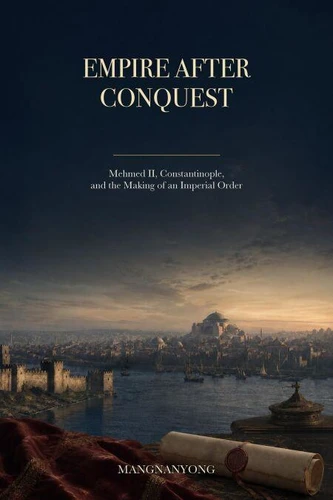
At twelve, Mehmed inherited a throne he could not yet command. At nineteen, he took it back. Two years later, Constantinople fell. But conquest was only the beginning. The city Mehmed seized in 1453 was wounded, underpopulated, and expensive to hold. Turning it into the center of an empire required forced migration and invitation, patronage and punishment, law and improvisation. Beyond its walls, victory opened one frontier only to expose another-from Belgrade and the Balkans to Anatolia, the Black Sea, Rhodes, and Otranto.
Empire After Conquest follows Mehmed II beyond the famous siege, tracing the full arc of a ruler who tried to bind ruined cities, rival elites, resistant provinces, and competing heirs into a durable imperial order. Written as immersive narrative history and grounded in the limits of the surviving sources, it neither celebrates the conqueror nor reduces him to a monster. It asks the harder question: what survives after a great victory-and who pays for what endures?
At twelve, Mehmed inherited a throne he could not yet command. At nineteen, he took it back. Two years later, Constantinople fell. But conquest was only the beginning. The city Mehmed seized in 1453 was wounded, underpopulated, and expensive to hold. Turning it into the center of an empire required forced migration and invitation, patronage and punishment, law and improvisation. Beyond its walls, victory opened one frontier only to expose another-from Belgrade and the Balkans to Anatolia, the Black Sea, Rhodes, and Otranto.
Empire After Conquest follows Mehmed II beyond the famous siege, tracing the full arc of a ruler who tried to bind ruined cities, rival elites, resistant provinces, and competing heirs into a durable imperial order. Written as immersive narrative history and grounded in the limits of the surviving sources, it neither celebrates the conqueror nor reduces him to a monster. It asks the harder question: what survives after a great victory-and who pays for what endures?

 , qui est-ce ?