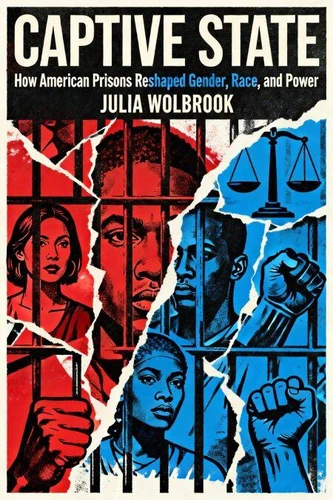
Captive State How American Prisons Reshaped Gender, Race, and Power
Par :Formats :
Disponible dans votre compte client Decitre ou Furet du Nord dès validation de votre commande. Le format ePub est :
- Compatible avec une lecture sur My Vivlio (smartphone, tablette, ordinateur)
- Compatible avec une lecture sur liseuses Vivlio
- Pour les liseuses autres que Vivlio, vous devez utiliser le logiciel Adobe Digital Edition. Non compatible avec la lecture sur les liseuses Kindle, Remarkable et Sony
 , qui est-ce ?
Notre partenaire de plateforme de lecture numérique où vous retrouverez l'ensemble de vos ebooks gratuitement
Pour en savoir plus sur nos ebooks, consultez notre aide en ligne ici
C'est si simple ! Lisez votre ebook avec l'app Vivlio sur votre tablette, mobile ou ordinateur :

- FormatePub
- ISBN8233553745
- EAN9798233553745
- Date de parution28/02/2026
- Protection num.pas de protection
- Infos supplémentairesepub
- ÉditeurLinda Balsamo
Résumé
What if the most influential institution in modern America isn't the school or the church, the corporation or the ballot box-but the prison?In Captive State, a searing and meticulously reported work of narrative nonfiction, the American penitentiary emerges not as a peripheral system of punishment but as a central architect of the nation's social order. With the narrative drive of a courtroom thriller and the analytical force of a landmark study, this book reveals how the prison system has quietly redrawn the boundaries of gender, recoded race into policy, and consolidated power in ways that reach far beyond prison walls.
Moving from the convict-lease camps of the post-Reconstruction South to the rise of mass incarceration in the late twentieth century, Captive State traces how carceral logics seeped into everyday life. The modern prison did more than confine bodies; it produced identities. It hardened racial hierarchies under the guise of neutrality. It redefined masculinity through surveillance and control. It rendered certain women hypervisible as subjects of discipline while erasing others entirely.
And it built a bureaucratic machinery whose influence now shapes schools, welfare offices, housing policy, and the very language of safety. At the heart of the book are unforgettable human stories, incarcerated mothers fighting to keep their families intact, prison laborers sustaining billion-dollar industries, correctional officers navigating a system that both empowers and consumes them. Throughout their lives, we see how incarceration became a governing philosophy, a means of organizing inequality, and a means of legitimizing state authority.
With intellectual clarity and moral urgency, Captive State challenges the comforting fiction that prisons are merely reactive institutions responding to crime. Instead, it argues that they are proactive engines of social design-institutions that have helped determine who counts as dangerous, who counts as worthy, and who counts at all.
Moving from the convict-lease camps of the post-Reconstruction South to the rise of mass incarceration in the late twentieth century, Captive State traces how carceral logics seeped into everyday life. The modern prison did more than confine bodies; it produced identities. It hardened racial hierarchies under the guise of neutrality. It redefined masculinity through surveillance and control. It rendered certain women hypervisible as subjects of discipline while erasing others entirely.
And it built a bureaucratic machinery whose influence now shapes schools, welfare offices, housing policy, and the very language of safety. At the heart of the book are unforgettable human stories, incarcerated mothers fighting to keep their families intact, prison laborers sustaining billion-dollar industries, correctional officers navigating a system that both empowers and consumes them. Throughout their lives, we see how incarceration became a governing philosophy, a means of organizing inequality, and a means of legitimizing state authority.
With intellectual clarity and moral urgency, Captive State challenges the comforting fiction that prisons are merely reactive institutions responding to crime. Instead, it argues that they are proactive engines of social design-institutions that have helped determine who counts as dangerous, who counts as worthy, and who counts at all.
A propos de Julia Wolbrook










2,99 €