
Nouveauté
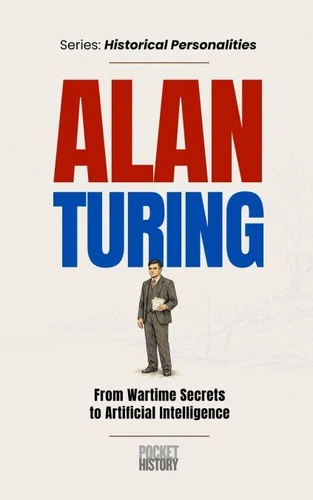
Alan Turing. Historical Personalities, #0
Par :Formats :
Disponible dans votre compte client Decitre ou Furet du Nord dès validation de votre commande. Le format ePub est :
- Compatible avec une lecture sur My Vivlio (smartphone, tablette, ordinateur)
- Compatible avec une lecture sur liseuses Vivlio
- Pour les liseuses autres que Vivlio, vous devez utiliser le logiciel Adobe Digital Edition. Non compatible avec la lecture sur les liseuses Kindle, Remarkable et Sony
 , qui est-ce ?
Notre partenaire de plateforme de lecture numérique où vous retrouverez l'ensemble de vos ebooks gratuitement
Pour en savoir plus sur nos ebooks, consultez notre aide en ligne ici
C'est si simple ! Lisez votre ebook avec l'app Vivlio sur votre tablette, mobile ou ordinateur :

- FormatePub
- ISBN8235064843
- EAN9798235064843
- Date de parution07/08/2026
- Protection num.pas de protection
- Infos supplémentairesepub
- ÉditeurIoakim Ioakim
Résumé
Discover the extraordinary life of Alan Turing, the brilliant mathematician whose ideas helped shape the modern digital world. Long before computers became part of everyday life, Turing was asking revolutionary questions about calculation, machines, intelligence, and the limits of mathematics. His theoretical concept of a universal computing machine became one of the foundations of computer science and influenced generations of researchers, engineers, and programmers.
During World War II, Turing joined the secret codebreaking operation at Bletchley Park. Working with other cryptanalysts, he made major contributions to the effort to decipher German Enigma communications and helped develop methods and machines that transformed wartime intelligence. His influence did not end with cryptography. Turing later explored one of the most important questions in technology: Can machines think? His 1950 paper on machine intelligence introduced what became known as the Turing Test, an idea that remains central to debates about artificial intelligence.
Yet behind these remarkable achievements was a deeply human story. Turing lived in a society that criminalized homosexuality, and the persecution he experienced has become an enduring reminder of the consequences of institutional prejudice. Combining science, history, espionage, technology, and biography, this accessible account reveals the remarkable mind behind some of the twentieth century's most influential ideas and explains why Alan Turing remains an essential figure in the story of computers and artificial intelligence.
During World War II, Turing joined the secret codebreaking operation at Bletchley Park. Working with other cryptanalysts, he made major contributions to the effort to decipher German Enigma communications and helped develop methods and machines that transformed wartime intelligence. His influence did not end with cryptography. Turing later explored one of the most important questions in technology: Can machines think? His 1950 paper on machine intelligence introduced what became known as the Turing Test, an idea that remains central to debates about artificial intelligence.
Yet behind these remarkable achievements was a deeply human story. Turing lived in a society that criminalized homosexuality, and the persecution he experienced has become an enduring reminder of the consequences of institutional prejudice. Combining science, history, espionage, technology, and biography, this accessible account reveals the remarkable mind behind some of the twentieth century's most influential ideas and explains why Alan Turing remains an essential figure in the story of computers and artificial intelligence.
A propos de Pocket History
5,49 €
5,49 €
5,49 €
5,49 €

5,49 €
5,49 €


5,49 €


5,49 €

5,49 €

5,49 €

5,49 €
5,49 €
5,49 €
5,49 €
5,49 €
5,49 €