This book argues that the twenty-first century is witnessing a profound transformation in the nature of power. Traditional explanations of national strength-territory, military capability, industrial capacity and economic wealth-remain important but are no longer sufficient to explain why some states and institutions consistently outperform others under conditions of accelerating geopolitical, technological and societal change.
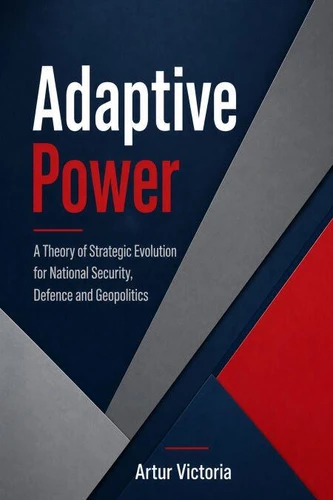
The central contribution of this work is the development of the theory of Adaptive Power, which proposes that long-term strategic success depends primarily on the capacity of institutions to evolve continuously rather than on the possession of static resources. The book introduces the concept of the Adaptive Century, an era in which adaptation itself becomes the principal determinant of national resilience, security and geopolitical influence.
Building upon insights from geopolitics, strategic studies, organizational theory, systems thinking, institutional economics and complexity science, the book presents an integrated framework based on four interconnected dimensions of national power: visible geography, invisible strategic infrastructures, institutional capacity and continuous adaptation. These dimensions are developed into a comprehensive doctrine through original concepts including the Adaptive State, Adaptive Governance, Adaptive Defence, Adaptive Intelligence, Cognitive Superiority, Adaptive Deterrence, Strategic Sovereignty and the Adaptive Power Index.
Rather than presenting adaptation as a managerial technique, the book establishes it as a new strategic paradigm capable of explaining the evolution of states, organizations and international competition in the twenty-first century. It offers policymakers, military leaders, scholars and strategic practitioners a unified conceptual framework for understanding power in an age increasingly defined not by stability, but by continuous transformation.
This book argues that the twenty-first century is witnessing a profound transformation in the nature of power. Traditional explanations of national strength-territory, military capability, industrial capacity and economic wealth-remain important but are no longer sufficient to explain why some states and institutions consistently outperform others under conditions of accelerating geopolitical, technological and societal change.
The central contribution of this work is the development of the theory of Adaptive Power, which proposes that long-term strategic success depends primarily on the capacity of institutions to evolve continuously rather than on the possession of static resources. The book introduces the concept of the Adaptive Century, an era in which adaptation itself becomes the principal determinant of national resilience, security and geopolitical influence.
Building upon insights from geopolitics, strategic studies, organizational theory, systems thinking, institutional economics and complexity science, the book presents an integrated framework based on four interconnected dimensions of national power: visible geography, invisible strategic infrastructures, institutional capacity and continuous adaptation. These dimensions are developed into a comprehensive doctrine through original concepts including the Adaptive State, Adaptive Governance, Adaptive Defence, Adaptive Intelligence, Cognitive Superiority, Adaptive Deterrence, Strategic Sovereignty and the Adaptive Power Index.
Rather than presenting adaptation as a managerial technique, the book establishes it as a new strategic paradigm capable of explaining the evolution of states, organizations and international competition in the twenty-first century. It offers policymakers, military leaders, scholars and strategic practitioners a unified conceptual framework for understanding power in an age increasingly defined not by stability, but by continuous transformation.