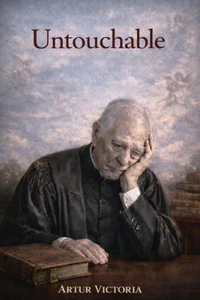
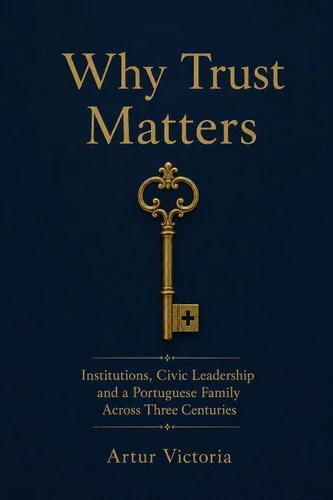
History is often written through wars, revolutions, monarchs and political leaders. Yet the continuity of nations depends less upon exceptional events than upon the institutions that quietly preserve justice, education, charity, public administration and civic responsibility across generations. This book explores that hidden dimension of history through an extensive documentary archive preserved by one Portuguese family whose members, over several centuries, served the judiciary, municipal government, the University of Coimbra, the Santa Casa da Misericórdia and regional economic development.
Rather than presenting a conventional genealogy or biography, the work examines how trust becomes institutionalised, how public confidence is earned and transmitted, and why certain communities repeatedly produce individuals capable of assuming positions of responsibility. Through the historical experience of Viseu and the Pereira de Chaves de Sousa e Araújo Manuel family, the book argues that institutions are sustained not primarily by laws or political power but by character, education, moral continuity and the patient accumulation of civic trust.
By combining family archives with broader historical research, this study contributes not only to the history of one family but also to the institutional history of Portugal, demonstrating that the preservation of documentary memory allows individual lives to illuminate the wider evolution of a nation's civic culture. Ultimately, this book is an exploration of the invisible foundations upon which enduring societies are built.
History is often written through wars, revolutions, monarchs and political leaders. Yet the continuity of nations depends less upon exceptional events than upon the institutions that quietly preserve justice, education, charity, public administration and civic responsibility across generations. This book explores that hidden dimension of history through an extensive documentary archive preserved by one Portuguese family whose members, over several centuries, served the judiciary, municipal government, the University of Coimbra, the Santa Casa da Misericórdia and regional economic development.
Rather than presenting a conventional genealogy or biography, the work examines how trust becomes institutionalised, how public confidence is earned and transmitted, and why certain communities repeatedly produce individuals capable of assuming positions of responsibility. Through the historical experience of Viseu and the Pereira de Chaves de Sousa e Araújo Manuel family, the book argues that institutions are sustained not primarily by laws or political power but by character, education, moral continuity and the patient accumulation of civic trust.
By combining family archives with broader historical research, this study contributes not only to the history of one family but also to the institutional history of Portugal, demonstrating that the preservation of documentary memory allows individual lives to illuminate the wider evolution of a nation's civic culture. Ultimately, this book is an exploration of the invisible foundations upon which enduring societies are built.

 , qui est-ce ?