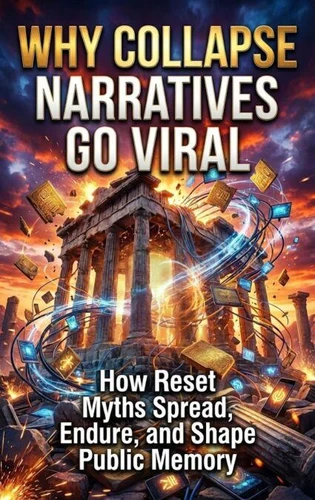
Why Collapse Narratives Go Viral. How Reset Myths Spread, Endure, and Shape Public Memory
Par :Formats :
Disponible dans votre compte client Decitre ou Furet du Nord dès validation de votre commande. Le format ePub est :
- Compatible avec une lecture sur My Vivlio (smartphone, tablette, ordinateur)
- Compatible avec une lecture sur liseuses Vivlio
- Pour les liseuses autres que Vivlio, vous devez utiliser le logiciel Adobe Digital Edition. Non compatible avec la lecture sur les liseuses Kindle, Remarkable et Sony
 , qui est-ce ?
Notre partenaire de plateforme de lecture numérique où vous retrouverez l'ensemble de vos ebooks gratuitement
Pour en savoir plus sur nos ebooks, consultez notre aide en ligne ici
C'est si simple ! Lisez votre ebook avec l'app Vivlio sur votre tablette, mobile ou ordinateur :

- Nombre de pages219
- FormatePub
- ISBN978-3-565-27451-2
- EAN9783565274512
- Date de parution26/02/2026
- Protection num.pas de protection
- Taille2 Mo
- Infos supplémentairesepub
- ÉditeurEmphaloz Publishing House
Résumé
Every generation produces its own version of the end. From millenarian movements in medieval Europe to twentieth-century fears of nuclear annihilation, the idea that civilization stands on the edge of collapse has proven remarkably durable-and remarkably contagious. The Collapse Narrative examines why stories of systemic breakdown spread faster than facts, and how they become organizing myths for communities seeking meaning in uncertain times.
Drawing on historical case studies across cultures and centuries, this book traces the recurring patterns behind reset narratives: the scapegoating of institutions, the longing for a purified world, and the deep human need to impose order on chaos.
It explores how ancient apocalyptic traditions migrated into modern political movements, digital communities, and mainstream media cycles-gaining new velocity with each technological leap. Neither dismissive nor credulous, this is a rigorous cultural and intellectual history of collapse thinking-one that takes seriously both the anxieties driving these narratives and the historical record they routinely distort.
It explores how ancient apocalyptic traditions migrated into modern political movements, digital communities, and mainstream media cycles-gaining new velocity with each technological leap. Neither dismissive nor credulous, this is a rigorous cultural and intellectual history of collapse thinking-one that takes seriously both the anxieties driving these narratives and the historical record they routinely distort.
A propos de Thalia Brookstone










8,99 €